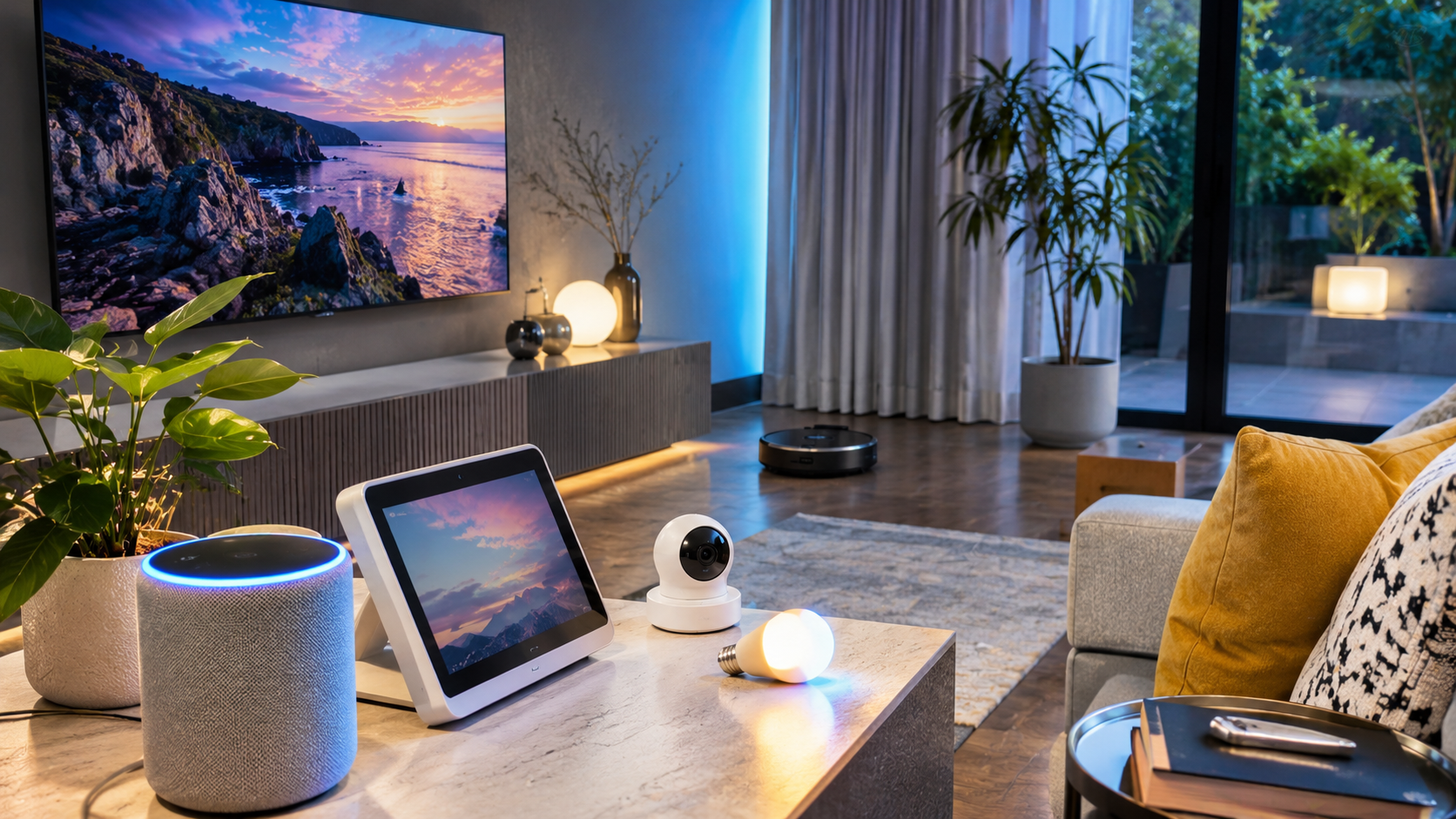



The most promising 2027 home tech trends focus on making existing household technology work better together, reducing wasted energy, improving everyday security, and automating repetitive chores. Smarter thermostats, connected energy monitors, Matter-compatible devices, and more capable cleaning robots could deliver meaningful benefits. The biggest improvement may not be a new gadget at all, but a home that needs fewer apps, fewer commands, and less attention.
With CES 2027 scheduled for January 6–9 in Las Vegas, the next generation of home technology is already attracting interest. The event will highlight artificial intelligence, robotics, connected appliances, energy innovation, and smart home systems. However, products shown at a technology exhibition do not necessarily become affordable, widely available, or practical immediately afterward.
There is an important distinction between technologies already available in 2026 and developments expected to gain momentum in 2027. Matter interoperability, connected energy management, and AI-assisted home devices have established foundations. More advanced household robots and fully autonomous home systems remain less predictable.
For homeowners, renters, and families planning upgrades in 2027, the most useful approach is to separate measurable improvements from ambitious marketing claims. A device should solve a real household problem, work with existing equipment, and remain usable for years.
What Are the Biggest Home Tech Trends for 2027?
The leading home tech trends for 2027 are likely to involve better interoperability, more sophisticated energy management, practical AI assistance, improved home security, and greater automation of routine household tasks. These developments are supported by technologies and industry standards introduced or expanded during 2025 and 2026.
The strongest trend is a shift away from buying individual connected devices simply because they support an app. Instead, attention is moving toward home systems that coordinate lighting, heating, security, appliances, and energy consumption without constant intervention.
The following comparison distinguishes established technologies from areas where progress remains uncertain.
| 2027 home tech trend | Potential everyday benefit | Technology status | Buying outlook |
| Matter-compatible smart homes | Easier control across supported brands | Established standard, expanding adoption | Worth considering now |
| Smart energy management | Better visibility and control of electricity use | Established technology, evolving integration | Useful for suitable households |
| Smarter heating and cooling | More convenient temperature management | Available, with newer capabilities developing | Worth considering when compatible |
| AI-assisted home automation | Less repetitive setup and more adaptive routines | Some features available, others emerging | Compare actual functions |
| Privacy-focused home security | Better control of cameras and personal data | Available, interoperability improving | Worth prioritizing |
| Advanced cleaning robots | Less manual floor maintenance | Available, with capabilities improving | Buy for specific needs |
| Home backup and resilience technology | Better preparation for electricity or internet disruptions | Established equipment, integration developing | Depends on local needs |
| Indoor environment monitoring | More information about air quality, humidity, and comfort | Established sensors, broader integration emerging | Useful when readings lead to action |
Some of these home technology trends can deliver benefits immediately, while others may become more attractive as additional compatible devices arrive in 2027.
The most practical home upgrade is usually the one that addresses an existing inconvenience rather than creating a new system that needs constant maintenance.
1. Matter-Compatible Devices Could Make Smart Homes Easier to Manage
Matter interoperability is among the most important 2027 home tech trends because it aims to reduce compatibility problems between different smart home brands and platforms. Instead of depending entirely on one manufacturer's proprietary system, supported devices can use a common standard for communication and control.
The technology has progressed significantly beyond its original device categories. Matter 1.5, released in November 2025, introduced support for cameras, closures, soil sensors, and additional energy-management features.
Matter 1.6 followed in June 2026, introducing improvements to device setup, cross-platform administration, thermostat interactions, and device-status information.
These developments provide a credible foundation for broader compatibility in 2027. However, the release of a specification does not mean that every manufacturer or smart home platform immediately supports all its features.
Will Matter Devices Work With Apple, Google, and Amazon in 2027?
Matter is designed to improve interoperability between supported ecosystems, including those developed by Apple, Google, Amazon, and other participating companies. Nevertheless, compatibility depends on the exact device, its firmware, the controlling platform, and which Matter features have been implemented.
A Matter-compatible light bulb may support basic functions across several ecosystems while offering advanced lighting effects only through the manufacturer's own application.
Likewise, a camera using a newer Matter specification should not be assumed to offer identical recording, detection, and notification features in every smart home app.
Before buying a connected product, check:
- Matter certification. Confirm that the specific model supports the standard.
- Supported device functions. Verify which capabilities work through Matter.
- Platform compatibility. Check whether the intended ecosystem supports that device category.
- Connectivity requirements. Determine whether the product uses Wi-Fi, Thread, Ethernet, or another supported connection.
- Controller requirements. Confirm whether additional hardware is necessary.
- Software support. Check the manufacturer's update policy.
The distinction between Matter and Thread is particularly important.
Matter is an interoperability standard, while Thread is a low-power mesh-network technology that some Matter devices use for communication. A Thread-based device may need a compatible Thread border router to connect with the rest of the home network.
Not every Matter device uses Thread, and not every Thread device supports Matter.
Should You Replace Existing Smart Home Devices With Matter Products?
Replacing functioning equipment solely to obtain Matter compatibility is usually unnecessary. A stable smart lighting system, thermostat, or security setup can continue delivering value even if it relies on an older integration method.
Matter becomes more important when adding devices from different manufacturers, replacing obsolete equipment, or building a new smart home from the beginning.
2027 outlook: Wider implementation of Matter 1.5 and 1.6 capabilities is plausible, but availability will vary by manufacturer. The practical benefit to watch is whether products become easier to set up and control together, not simply whether their packaging displays a Matter logo.
2. Smart Energy Management Could Become More Useful Than Smart Lighting
Energy management is one of the most practical home technology trends for 2027 because it can help households understand where electricity is being consumed and when certain appliances operate. Smart plugs, energy monitors, compatible thermostats, and connected electrical systems can provide information that traditional household equipment does not display.
For example, an energy-monitoring plug may reveal how much electricity a desktop computer, television, or entertainment system uses over several days. A compatible automation could then switch off nonessential equipment when it is no longer needed.
However, monitoring energy consumption does not automatically reduce it. Savings come from identifying unnecessary use and making changes that do not compromise safety or comfort.
Can Smart Plugs Actually Lower Electricity Bills?
Smart plugs can reduce electricity waste when they control devices that consume avoidable power while idle. Their benefit depends on the appliance, the duration of unnecessary operation, and the local electricity price.
Consider a hypothetical device consuming 10 watts continuously.
Over one year, its electricity consumption would be:
10 W × 24 hours × 365 days ÷ 1,000 = 87.6 kWh.
At an illustrative electricity price of $0.25 per kWh, that represents approximately $21.90 per year.
If a smart plug eliminated that consumption entirely, the theoretical annual saving would approach that amount. In practice, the plug itself uses some electricity, the appliance may need standby power, and the household may not be able to disconnect it continuously.
The example demonstrates why measurements matter. A device using less than one watt in standby mode offers much smaller potential savings.
Before purchasing energy-monitoring equipment, check whether it can measure actual power consumption rather than merely switch devices on and off.
Which Appliances Should Not Be Connected to Ordinary Smart Plugs?
Not every appliance is suitable for connection through a standard smart plug. High-power devices, equipment that requires uninterrupted operation, and appliances with specific electrical safety requirements need particular care.
A smart plug should never be used beyond its rated electrical capacity. It should also be appropriate for the local voltage and electrical system.
Examples requiring additional caution include:
- Space heaters and other high-power heating equipment.
- Refrigerators, freezers, and appliances that require continuous power.
- Medical equipment or devices that must not switch off unexpectedly.
- Motorized equipment with high startup currents.
- Appliances whose manufacturers prohibit external switching controls.
A smart plug's current or wattage rating is not sufficient on its own to establish compatibility with every type of load. Manufacturer instructions and relevant electrical safety requirements take priority.
For heating products, the electric blanket safety checklist for winter 2026 explains why automatic timers and connected accessories do not replace correct positioning, inspection, and the manufacturer's operating instructions.
Will Home Energy Systems Become Smarter in 2027?
More coordinated energy management is a credible direction for 2027. Matter already includes expanding energy-related capabilities, and manufacturers are developing systems that connect household consumption with compatible appliances, batteries, solar equipment, and electricity tariffs.
A future home energy system might automatically schedule certain nonurgent tasks when electricity is less expensive or when solar generation is available. The usefulness of such functions depends on the household's electricity contract, connected equipment, and available automation.
2027 outlook: Better integration between energy monitors and household appliances is worth watching. Claims that a smart home system can reduce an electricity bill by a fixed percentage should be treated cautiously unless supported by measurements relevant to the household.
3. Smarter Thermostats and Climate Controls Could Improve Everyday Comfort
Smart climate control is likely to remain an important home tech trend in 2027 because heating and cooling account for a substantial share of energy use in many households. Compatible thermostats, room sensors, and automated schedules can help maintain comfort without requiring constant manual adjustments.
The next development is not necessarily a thermostat with more settings. It is a system that better understands occupancy, household preferences, and the interaction between different heating or cooling devices.
Matter 1.6 introduced a capability called Thermostat Suggestions. This allows a compatible ecosystem to send a recommendation that a thermostat can evaluate against its settings and current conditions rather than blindly following every incoming command.
That provides a technical foundation for more predictable interactions between connected climate systems, although implementation will depend on manufacturers.
Are Smart Thermostats Worth Buying in 2027?
A smart thermostat is worth considering when the heating or cooling system supports it and the household can benefit from scheduling, remote adjustments, or occupancy-based control.
For a home with central heating or air conditioning, a suitable thermostat may reduce unnecessary operation when nobody is present. However, the amount saved varies with insulation, climate, equipment efficiency, occupancy, and previous thermostat settings.
A household that already manages temperatures efficiently may see only modest benefits.
Before buying, verify:
- Heating-system compatibility. Check whether the thermostat supports the installed equipment.
- Wiring requirements. Confirm whether professional installation or additional electrical connections are necessary.
- Room sensors. Determine whether temperature can be measured where people actually spend time.
- Offline operation. Check what happens when the internet connection fails.
- Manual controls. Confirm that essential functions remain accessible without a smartphone.
- Integration support. Review compatibility with existing home automation systems.
Homes using radiators, district heating, heat pumps, electric heaters, or underfloor heating may require different control equipment. A thermostat designed for a typical U.S. forced-air system cannot automatically be installed in every European or Ukrainian home.
Will AI Automatically Control Heating in 2027?
AI-assisted climate control may become more sophisticated, but full automation should not be assumed. Some systems already use occupancy patterns, weather information, and user preferences to suggest or apply adjustments.
The important question is whether these functions improve comfort without overriding essential settings.
A useful smart heating system should allow residents to establish temperature limits, change schedules, and intervene whenever necessary.
2027 outlook: More context-aware climate automation is plausible, especially in newer integrated systems. The value will depend on compatibility and measurable performance rather than the presence of an AI label.
4. AI-Powered Smart Homes May Finally Become Less Complicated
Artificial intelligence is expected to remain a prominent theme in home technology during 2027, but its most useful applications may be less visible than manufacturers' promotional demonstrations. Instead of requiring residents to create complicated rules, AI could make connected devices easier to operate and automate.
Some AI-assisted home functions already exist. Cameras can classify certain events, robot vacuums can identify obstacles, and voice assistants can interpret natural-language requests.
The next challenge is making these capabilities work consistently across devices while respecting user preferences and privacy.
What Could AI Actually Do in a Smart Home in 2027?
Useful AI applications may include more flexible routines, improved device troubleshooting, and automation based on specific household conditions.
For example, a connected home could potentially combine occupancy information, outdoor conditions, and user-defined comfort preferences when adjusting lighting or climate controls.
An energy-management system might identify unusual consumption patterns and notify residents before a utility bill increases substantially.
These applications are more practical than simply adding a chatbot interface to an appliance.
Potential improvements include:
- Natural-language automation. Creating routines through ordinary instructions rather than complex menus.
- Device troubleshooting. Identifying common connection or configuration problems.
- Context-aware control. Adjusting settings according to occupancy and user preferences.
- Energy analysis. Highlighting unusual or unnecessary power consumption.
- Maintenance notifications. Detecting patterns that may indicate a developing equipment problem.
- Accessibility improvements. Making devices easier to operate for people with different physical needs.
These are possible areas of development, not guaranteed capabilities of every 2027 product.
Is Local AI Better Than Cloud-Based AI for Smart Homes?
Local AI can offer advantages when processing happens directly on a device or compatible home controller. Depending on the design, it may reduce the need to transmit certain data to remote servers and allow some functions to operate without an internet connection.
Cloud processing can provide access to more demanding computational tasks, but it may depend on network availability, account access, and ongoing service support.
Neither approach automatically guarantees privacy or security. Local systems still require secure software, while cloud services need appropriate data handling and account protections.
A useful comparison should answer three questions: what data is collected, where it is processed, and what happens when the service is unavailable.
2027 outlook: More devices may advertise on-device AI, but buyers should look for specific functions that work locally. Paying substantially more for vague promises of autonomous home intelligence is difficult to justify.
5. Home Security Cameras Could Become More Compatible and Privacy-Focused
Connected home security is another area where 2027 home tech trends could bring meaningful improvements. The expansion of Matter to cameras and video doorbells creates opportunities for more flexible integration between supported products and smart home platforms.
Matter 1.5 introduced camera support, while version 1.5.1 improved aspects of camera streaming and related devices in March 2026.
These updates establish technical capabilities, but actual compatibility still depends on which features manufacturers and smart home platforms implement.
A camera that works well with one ecosystem may not provide identical recording, notification, or storage options through another.
What Should a Smart Security Camera Offer in 2027?
A useful camera should provide reliable recording, appropriate image quality, secure account access, and clear information about data storage. Advanced AI features are secondary if basic security or reliability is poor.
The strongest purchasing criteria include:
- Reliable event recording. Important activity should be captured consistently.
- Clear storage options. Buyers should understand whether recordings are stored locally, in the cloud, or both.
- Software support. The manufacturer should provide security updates for a clearly stated period.
- Account protection. Strong passwords and multifactor authentication should be supported where applicable.
- Privacy controls. Recording zones, microphone controls, and access permissions should be understandable.
- Backup behavior. The system should clearly explain what happens during internet or power failures.
- Subscription costs. Important functions should not be hidden behind unexpected recurring fees.
Local recording can reduce dependence on a cloud subscription, but it does not eliminate security responsibilities. The storage device may still need protection against physical theft, unauthorized access, or equipment failure.
Are Subscription-Free Security Cameras Better?
Subscription-free cameras can offer better long-term value when their included recording and notification features meet household needs. However, the absence of a monthly fee does not automatically mean the camera is more secure or reliable.
Some cloud services provide off-site backups that remain available if the camera or local recorder is stolen. Local-only recording may be more vulnerable to that particular situation.
The better arrangement depends on the security requirements, available backup options, and privacy preferences.
Could Smart Cameras Replace Traditional Home Security Systems?
Connected cameras can supplement home security, but they should not automatically replace properly installed alarms, door locks, or other protective measures. A camera may record an event without preventing it.
Similarly, smart smoke and carbon monoxide alarms must meet applicable safety requirements. A phone notification is not a substitute for an appropriate local audible alarm.
2027 outlook: More flexible camera interoperability is a realistic development to monitor. Buyers should prioritize proven recording, security support, and privacy controls over elaborate AI detection claims.
6. Robot Vacuums Could Become More Independent, but Not Fully Autonomous
Robot vacuums are among the most visible examples of practical home automation. In 2027, improvements in obstacle detection, navigation, cleaning stations, and software coordination may make these devices more convenient.
Modern models can already map rooms, schedule cleaning, recognize selected obstacles, and return to docking stations. Some also include automated dust collection and mop-maintenance functions.
Further improvements are plausible, but no technology guarantees that a robot will handle every household layout without intervention.
Which Robot Vacuum Features Will Matter Most in 2027?
Reliable navigation and cleaning performance should take priority over unusual features that rarely improve results. The ideal device depends on flooring, furniture, thresholds, pets, and the amount of clutter typically present.
For example, a home with several rugs may need different capabilities from an apartment with mostly hard floors. Pet owners may prioritize hair collection and obstacle recognition.
| Feature | Practical benefit | Main limitation |
| Accurate room mapping | More predictable cleaning routes | Maps may need updating after furniture changes |
| Obstacle detection | Helps avoid selected objects | Small cables and unusual obstacles may still cause problems |
| Automatic dust emptying | Reduces routine bin emptying | Requires bags or periodic station maintenance |
| Mop washing and drying | Reduces some manual cleaning tasks | Water tanks and cleaning components still need attention |
| Carpet recognition | Can adapt cleaning behavior | Performance varies by model and flooring |
| Multi-floor maps | Useful in larger homes | The robot may still need to be carried between floors |
| Advanced object recognition | May help with clutter and pet-related obstacles | Recognition is not infallible |
Automated cleaning stations can reduce routine maintenance, but they also introduce additional components, consumables, and potential repair costs.
A robot that empties dust automatically may still require regular brush cleaning, filter changes, and sensor inspection.
Are Robot Vacuums With AI Object Recognition Worth It?
AI object recognition is useful when it reliably prevents the robot from becoming trapped or damaging household items. However, recognition quality varies by manufacturer and model.
The presence of a camera or AI processor does not guarantee that the device can identify every cable, toy, spill, or pet-related obstacle.
Privacy also matters when robots use cameras to navigate indoor spaces. Buyers should check whether images are processed locally, uploaded to cloud services, or stored for troubleshooting.
Should You Wait for New Robot Vacuums at CES 2027?
Waiting may make sense if the current product selection does not address an important problem, such as high thresholds, complicated room layouts, or poor obstacle handling.
However, a new demonstration at CES does not guarantee that the product will reach stores quickly or perform as advertised under normal household conditions.
2027 outlook: Better cleaning automation is a reasonable expectation. Fully independent household robots that reliably manage every cleaning task remain a much more speculative proposition.
7. Backup Power and More Resilient Home Networks Could Become Essential Upgrades
Reliable home connectivity and backup power are likely to remain important home technology trends in 2027, particularly in areas affected by electricity interruptions, unstable internet service, or extreme weather.
The practical objective is straightforward: keep essential equipment operating safely when normal household services become unavailable.
A home does not necessarily need an expensive battery system to achieve basic resilience. Sometimes the highest-value improvements involve identifying essential devices, understanding their electricity requirements, and choosing an appropriate backup solution.
What Home Technology Is Most Useful During a Power Outage?
The most useful equipment depends on what must remain operational during an interruption. Communication devices, essential lighting, and certain networking equipment are common priorities.
A household may consider:
- A suitable backup power source for a router and modem.
- Rechargeable LED lighting.
- A properly selected UPS for equipment requiring uninterrupted operation.
- A portable power station for compatible essential devices.
- Battery-powered communication equipment.
- Appropriate surge protection and electrical safety measures.
- A written plan for maintaining necessary services.
Power stations and UPS devices are not interchangeable in every situation. A portable power station may briefly interrupt output when switching to battery power, while a compatible UPS is designed around specified backup and transfer characteristics.
The correct choice depends on the equipment being protected.
How Long Can Backup Power Run a Router?
Runtime depends on battery capacity, the power consumption of connected equipment, and conversion losses. Product advertisements cannot establish the exact result without these details.
A hypothetical backup battery with 200 Wh of nominal capacity and 80% usable energy after losses would provide approximately 160 Wh.
If a router and modem together consumed 20 W, the estimated runtime would be about eight hours.
That is an illustrative calculation, not a performance guarantee. Real output depends on the battery, voltage conversion, connected devices, and operating conditions.
For homes combining communication equipment with a small workstation, the mini PC vs. laptop comparison for 2027 explains how hardware power requirements and backup options can affect a home office.
Can a Smart Home Work Without Internet?
Some smart home functions can continue operating without an internet connection, but this depends on their architecture and equipment. A local Matter controller and compatible devices may support certain local automations even when external internet access is unavailable.
Cloud-dependent cameras, voice services, and remote notifications may stop working.
The distinction between losing internet access and losing electricity is also important. A local automation cannot operate if the equipment needed to run it has no power.
For network problems that occur while devices remain connected to Wi-Fi, the guide to fixing Wi-Fi connected without internet covers the checks that separate router problems from internet-service interruptions.
Is Wi-Fi 7 Worth Upgrading to in 2027?
Wi-Fi 7 can provide improvements in suitable environments, including additional networking capabilities and potentially higher throughput with compatible equipment. However, replacing a functioning router solely because a newer Wi-Fi standard exists may offer little noticeable benefit.
Actual performance depends on broadband speed, device compatibility, interference, placement, and the network's physical environment.
For a home with poor coverage, a better router location or suitable mesh system may solve more problems than purchasing the fastest available router.
2027 outlook: More attention to local operation, backup power, and resilient home infrastructure is a credible trend. The most useful solutions will be those that work reliably when ordinary connectivity is disrupted.
8. Indoor Air Quality and Environmental Sensors Could Become More Practical
Smart environmental monitoring is one of the quieter home tech trends for 2027, but it can offer practical benefits for comfort and household maintenance. Connected humidity, temperature, air-quality, and water-leak sensors can help residents notice conditions that might otherwise remain unnoticed.
The key advantage is information that leads to an appropriate response. A sensor that sends frequent notifications without providing useful context can become more irritating than helpful.
For example, a humidity sensor may help identify persistent moisture in a bathroom or poorly ventilated room. A leak sensor placed near a washing machine may provide early warning of water reaching the floor.
These devices do not eliminate the underlying causes of moisture or leaks. They make certain problems easier to notice.
Which Smart Home Sensors Are Worth Buying in 2027?
The most useful sensors address identifiable household risks or recurring discomfort.
Their value depends on placement, measurement quality, maintenance, and whether residents can act on the information.
| Sensor type | What it can help monitor | Important limitation |
| Temperature sensor | Room comfort and heating conditions | Placement affects measurements |
| Humidity sensor | Excess moisture or unusually dry air | Does not identify the cause of moisture |
| CO2 monitor | Indoor carbon dioxide concentration | Requires suitable sensor quality and calibration |
| Particulate matter sensor | Selected airborne particles | Cannot identify every indoor pollutant |
| Water-leak sensor | Water contacting the detection area | Cannot detect leaks outside its coverage |
| Door and window sensor | Opening and closing events | Does not prove that a property is secure |
| Soil moisture sensor | Moisture in plant-growing media | Readings depend on sensor placement and soil conditions |
A CO2 monitor can help assess ventilation conditions in occupied rooms, but it is not a carbon monoxide detector. These devices measure different gases and serve different purposes.
Similarly, a general air-quality monitor cannot replace certified smoke or carbon monoxide alarms.
Can Smart Air Quality Monitors Improve Health?
An air-quality monitor can provide information that supports decisions about ventilation, filtration, and indoor environmental conditions. However, its readings do not automatically improve health, and inexpensive sensors can vary considerably in accuracy.
A particulate matter monitor may help evaluate whether a compatible air purifier is reducing certain airborne particles. A humidity sensor may reveal patterns associated with moisture buildup.
The benefit comes from making appropriate changes and checking whether conditions improve.
For indoor air quality, avoid relying on devices that advertise vague overall air-quality scores without explaining what they measure.
2027 outlook: Better integration between environmental sensors, ventilation, and climate-control systems is plausible. The strongest products will provide understandable measurements and useful actions rather than another collection of unexplained numbers.
Which 2027 Home Tech Trends Are Worth Buying Now and Which Should Wait?
The best purchase timing depends on whether the technology already solves a household problem or relies on capabilities that are still being developed. Mature products can be worth buying before 2027, while emerging systems deserve closer inspection after independent testing becomes available.
CES 2027 may introduce interesting devices, but a launch announcement should not be confused with a finished product available at a known price.
The following framework separates sensible current purchases from upgrades that may benefit from waiting.
| Technology | Buy now if | Wait if |
| Matter-compatible lighting | Existing equipment needs replacement and compatibility is verified | Current lighting works well |
| Energy-monitoring plugs | A measurable power-consumption problem exists | Expected savings are unclear |
| Smart thermostat | Heating system is compatible and scheduling would help | Installation requirements are uncertain |
| Smart security camera | There is a clear security or monitoring need | Desired interoperability is not yet supported |
| Robot vacuum | Cleaning performance meets household needs | An essential obstacle-handling feature is missing |
| Backup power | Essential equipment needs protection from outages | Electrical requirements have not been calculated |
| Environmental sensors | They address a specific moisture, ventilation, or leak concern | There is no plan to act on readings |
| AI home controller | Specific useful functions are already available | Benefits depend on future software promises |
Buying a product before CES is not inherently a mistake. A reliable, properly supported device can remain useful for years even if newer technology is announced.
The important distinction is between purchasing a proven capability and paying for a feature that may arrive later.
6 Home Tech Upgrades You Can Probably Skip in 2027
Several home technology trends attract attention because they look futuristic, but their practical value can be difficult to justify. Expensive hardware, recurring subscriptions, and uncertain software support can turn a seemingly convenient upgrade into another household expense.
The following six categories deserve particular skepticism unless they solve a clearly defined problem.
1. Smart Appliances That Only Add Voice Commands
A refrigerator or washing machine does not automatically become more useful because it supports a voice assistant. Basic remote notifications can be convenient, but they rarely justify replacing a reliable appliance.
Energy efficiency, cleaning performance, repairability, and expected service life should take priority.
A new connected appliance becomes more attractive when it offers measurable improvements or solves a recurring inconvenience, not simply because it adds an application.
2. Expensive AI Hubs Without Clearly Available Functions
Some smart home devices promise future AI capabilities without providing a detailed description of what is available at purchase. Paying a premium for unconfirmed features creates unnecessary risk.
Software roadmaps can change, hardware requirements may differ, and some functions could eventually require subscriptions.
A useful AI home controller should demonstrate its capabilities before purchase. If an essential function is described only as coming soon, it should not be included when calculating the product's current value.
3. Cameras That Require Subscriptions for Basic Features
A security camera with an affordable purchase price can become expensive if important functions require recurring payments. Cloud recording, event history, advanced notifications, and multiple-camera access may be priced separately.
Subscriptions can be worthwhile when they provide genuinely useful services. The problem arises when buyers discover the ongoing costs only after installation.
Before purchasing, calculate the total expected cost over several years and determine what remains functional if the subscription is canceled.
4. Premium Smart Displays That Duplicate Existing Devices
A dedicated smart display can be useful for household control, video calls, or accessibility. However, many families already own smartphones, tablets, televisions, and computers capable of performing similar tasks.
If the new display will mainly show the time, weather, or a small number of controls, an expensive model may offer limited additional value.
The more practical upgrade might be improving an existing device's position, connectivity, or usability.
5. Experimental Household Robots That Promise Too Much
Advanced robots capable of manipulating household objects could become more visible at technology events. However, a convincing demonstration does not establish that a robot can operate safely and reliably in an ordinary home.
Complex tasks involve unpredictable objects, different floor plans, pets, children, and numerous safety considerations.
For routine cleaning, a proven robot vacuum may deliver more value than an expensive experimental machine with uncertain capabilities.
6. Replacing Every Smart Device to Follow a New Standard
A new interoperability standard does not automatically make existing equipment obsolete. Replacing functional lights, switches, sensors, and controllers can generate substantial expense and electronic waste.
Before purchasing replacement hardware, check whether existing devices can receive software updates or connect through supported integration methods.
The goal of a smarter home should be less inconvenience, not a permanent cycle of replacing equipment whenever a new technology appears.
How Much Should You Spend on Smart Home Technology in 2027?
A practical smart home budget should start with the problem being solved rather than a target number of gadgets. Some improvements cost relatively little, while major energy, security, and automation projects can require professional installation.
The most economical purchases often involve relatively simple devices that improve lighting, provide useful alerts, or help manage existing equipment.
Approximate budget categories can help households identify realistic starting points.
| Illustrative budget | Possible upgrades | Main buying priority |
| Under $100 | Basic sensors, selected smart plugs, or compatible smart lighting | Solve one specific problem |
| $100–$300 | Selected home controllers, monitoring equipment, or networking upgrades | Compatibility and reliability |
| $300–$700 | Higher-end robot vacuums, selected home security systems, or backup equipment | Long-term functionality |
| Above $700 | Larger automation projects, advanced cleaning systems, or substantial power upgrades | Total ownership cost and professional requirements |
These ranges are illustrative, not verified retail quotes. Pricing depends on the country, product category, installation costs, and regional availability.
In the United States, labor costs and electrical requirements can substantially affect major installations. UK and EU households may face different wiring systems, equipment standards, and professional service costs.
For Ukrainian households, backup electricity and connectivity may be more important than convenience-oriented automation, particularly where interruptions affect daily activities.
What Is the Best First Smart Home Upgrade?
The best first upgrade is usually a simple, compatible device that solves a frequently encountered problem. A smart lighting system may help with daily routines, while a leak sensor could be more useful in a home where water damage is a concern.
The decision becomes easier when considering three factors: how often the problem occurs, how much inconvenience it causes, and whether the device reliably addresses it.
Before purchasing, check whether the new technology requires a hub, subscription, additional sensors, or professional installation. A seemingly inexpensive product can cost significantly more once these requirements are included.
What Will CES 2027 Reveal About the Future of Home Technology?
CES 2027 is scheduled for January 6–9 in Las Vegas, with media activities beginning earlier in the week. The event is expected to feature smart home technology, artificial intelligence, robotics, energy solutions, connected appliances, and other consumer electronics.
The show will provide an opportunity to evaluate manufacturers' plans, but the number of product announcements is less important than their actual readiness for household use.
A concept product can demonstrate an emerging direction without becoming commercially available. A finished product may still require several months before reaching international markets.
Which CES 2027 Smart Home Announcements Will Matter Most?
The most significant announcements will be those that demonstrate practical improvements in interoperability, reliability, operating costs, and maintenance.
A new Matter-compatible camera that works with several popular platforms could be more important than a visually impressive appliance that depends on one manufacturer's cloud service.
Likewise, an energy-management system with transparent reporting and proven compatibility would offer more practical value than a device making broad claims about AI-powered savings.
The strongest announcements should answer several questions:
- What problem does the technology solve? The benefit should be understandable without specialized knowledge.
- When will the product be available? A demonstration is not the same as a confirmed retail launch.
- Which markets will receive it? Availability can differ between North America, Europe, and other regions.
- What equipment does it require? Additional hubs, subscriptions, and installation costs should be clear.
- Will it work with existing devices? Compatibility should be confirmed rather than assumed.
- How long will it receive updates? Software support is essential for connected products.
- What happens without internet access? Essential functions should have clearly documented limitations.
A genuine technology breakthrough should improve how a home operates, not merely introduce another category of connected equipment.
Will CES 2027 Products Be Available Immediately?
Not necessarily. Some manufacturers may announce retail-ready devices, while others demonstrate prototypes or technologies intended for later development.
Availability can also vary significantly by country. A product introduced for the U.S. market may not be compatible with European electrical systems or may require different wireless certifications.
For buyers outside the initial launch region, warranty support, replacement parts, and local service availability deserve attention.
A CES announcement should be treated as information about a potential future purchase until real pricing, availability, and independently tested performance are established.
How to Prepare Your Home for 2027 Technology Without Buying New Gadgets
Preparing for future home technology can begin with the equipment already installed. Reliable networking, updated software, organized device accounts, and an understanding of household electricity use create a stronger foundation than purchasing additional connected products at random.
Several improvements may cost nothing.
Check Your Home Network and Existing Smart Devices
A connected home depends on a reliable network, but every household does not need the newest router standard. Device placement, coverage, interference, and firmware support can affect the experience more than a headline maximum speed.
Before replacing equipment, review the existing network.
A practical preparation checklist includes:
- Update the router. Install supported firmware updates and confirm that the device still receives security fixes.
- Review connected devices. Identify unfamiliar or unused products and remove access where appropriate.
- Check Wi-Fi coverage. Find areas where connected equipment frequently disconnects.
- Secure accounts. Use unique passwords and multifactor authentication where available.
- Review app permissions. Remove unnecessary access to cameras, microphones, and location information.
- Test local functions. Determine what essential devices can do without internet service.
- Record device details. Keep model numbers, warranty information, and support policies accessible.
- Identify unnecessary subscriptions. Cancel services that no longer provide useful benefits.
These checks can improve reliability before any new equipment is purchased.
Create a Simple Smart Home Upgrade Plan
The strongest home technology projects begin with a list of household problems rather than product categories.
A family might identify three priorities: unreliable Wi-Fi in a bedroom, excessive heating in an unused room, and concern about a possible water leak near a washing machine.
Each problem calls for a different type of intervention. The Wi-Fi issue may require better network coverage, while heating management depends on the installed climate system. A water-leak sensor may provide an alert but cannot replace repairing faulty plumbing.
Only after identifying the problem should a product be selected.
This approach also helps avoid incompatible purchases. Buying several devices from unrelated ecosystems without checking integration can create more work than the products save.
How to Choose Home Tech That Will Still Be Useful After 2027
A connected device should remain useful beyond its launch year. Long software support, reliable manual controls, repairability, and transparent subscription policies are more important than having the latest feature on the day of purchase.
This is especially relevant to technology that depends on cloud services. A product may continue functioning physically while losing important features if the manufacturer discontinues its online platform.
Before buying, check the expected support period and what happens when remote services are unavailable.
What Makes Smart Home Technology Future-Proof?
No device is completely future-proof, but several characteristics reduce the risk of early obsolescence.
The most important qualities include:
- Recognized standards. Broadly supported protocols can make integration easier.
- Documented security support. A manufacturer should explain how long updates will be provided.
- Useful offline functions. Basic operation should not depend unnecessarily on cloud access.
- Replaceable components. Batteries, filters, and other consumables should remain available.
- Clear subscription terms. Important functions and ongoing charges should be transparent.
- Reliable manual controls. Essential household equipment should remain practical to operate.
- Accessible technical information. Installation requirements and compatibility should be understandable.
For products sold in the European Union, the Cyber Resilience Act is another development worth monitoring. Its main cybersecurity requirements are scheduled to apply from December 11, 2027, while certain vulnerability and incident reporting obligations began in September 2026.
The legislation is intended to strengthen security obligations for covered products with digital elements, including requirements related to vulnerability handling and product support.
However, the law should not be interpreted as a guarantee that every connected device already on the market will immediately receive every new protection. Application dates, product scope, and transitional rules matter.
For consumers worldwide, the practical lesson remains the same: choose manufacturers that explain their update policies and take long-term security seriously.
FAQ About 2027 Home Tech Trends
The biggest 2027 home tech trends include wider Matter interoperability, smarter energy management, AI-assisted automation, improved security cameras, advanced robot vacuums, connected climate control, backup power solutions, and indoor environmental monitoring. Adoption will vary by product and market.
Some connected devices may become more accessible as technology matures and manufacturers compete, but lower prices are not guaranteed. Compatibility, installation costs, subscriptions, and maintenance can influence the total cost more than the initial purchase price.
Matter is worth considering when compatibility across supported brands and ecosystems matters. However, buyers should confirm that the exact device and controlling platform support the required functions, since Matter certification does not guarantee identical features everywhere.
AI may enable more adaptive routines, natural-language controls, and useful device monitoring. Fully autonomous operation across all household equipment is not guaranteed, and many products will still require user settings, compatible hardware, and manual intervention.
Energy-monitoring plugs, suitable smart thermostats, compatible appliance scheduling, and integrated energy-management systems can help identify or reduce unnecessary electricity use. Actual savings depend on household behavior, equipment, tariffs, and measured consumption.
Waiting makes sense when an essential feature is not yet available or when a major purchase is not urgent. Existing, well-supported products can still be worthwhile, and CES announcements do not guarantee immediate availability or lower prices.
Potentially poor-value purchases include expensive AI hubs without proven functions, appliances that add only basic voice commands, security cameras with unexpectedly high subscription costs, and experimental robots with limited real-world capabilities. Their value depends on specific household needs.
Some compatible devices can operate locally without external internet access, but others depend on cloud services for control, recording, or notifications. Wi-Fi availability, internet connectivity, and electrical power are separate requirements, so offline behavior should be checked before purchase.