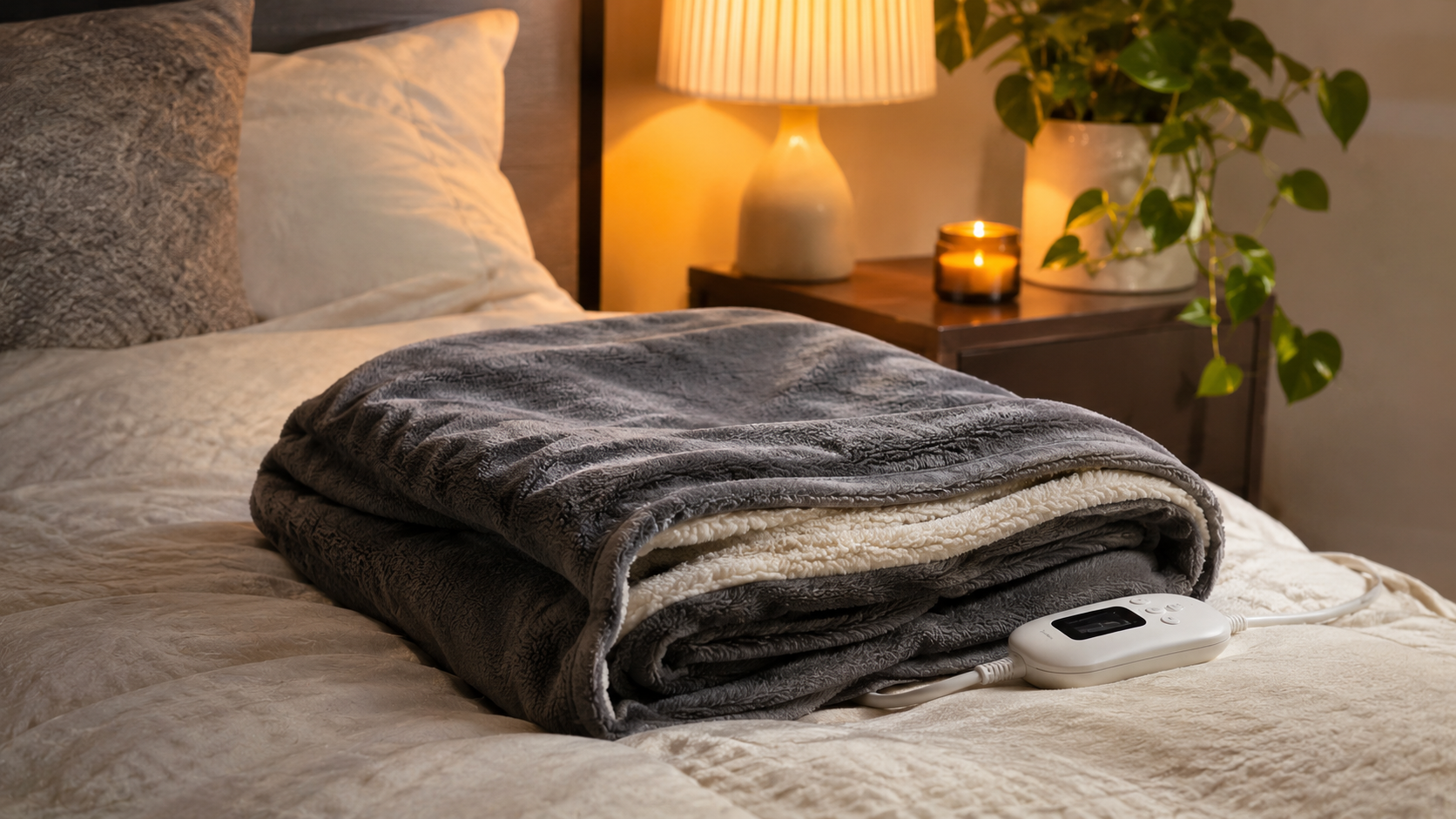



An electric blanket can make a cold bedroom more comfortable without heating an entire house, but incorrect use can cause burns, electric shock, or fire. The safest routine is to inspect the blanket before each winter, use it exactly as designed, keep it completely flat, and switch it off before sleeping unless the manufacturer explicitly permits overnight operation. A timer or adjustable temperature control alone is not proof that a product is suitable for all-night use.
As colder weather approaches in late 2026, households looking to reduce heating costs may be bringing older electric blankets out of storage or considering a new heated throw during November sales. Both situations require more than checking whether the blanket still turns on. Damaged wiring, recalled products, inappropriate bedding, and incorrect cleaning methods can create hazards even when the fabric appears normal.
This electric blanket safety checklist covers 12 essential precautions, including how to recognize dangerous wear, choose certified products, protect children and pets, and maintain heated bedding throughout winter.
Electric Blanket Safety Checklist – 12 Things to Check Before Use
An electric blanket should be inspected before the first use of the season and checked regularly afterward. The most important precautions concern the electrical components, heating elements, operating conditions, and manufacturer's instructions.
Use the following electric blanket safety checklist before plugging in a stored blanket or setting up a new one:
- Inspect the fabric. Look for scorch marks, discoloration, frayed edges, worn patches, exposed heating wires, and unusual lumps.
- Check the power cord. Make sure it is not cracked, crushed, frayed, twisted, or damaged near the plug or controller.
- Examine the controller. Confirm that its casing, buttons, display, and connectors are intact.
- Check for product recalls. Search the brand and model number in the relevant official product safety database.
- Read the manufacturer's instructions. Confirm how the product should be positioned, operated, cleaned, and stored.
- Spread the blanket completely flat. Never switch on heated bedding while it is folded, bunched up, or trapped under excessive pressure.
- Use the correct power connection. Plug it directly into a suitable wall outlet rather than an extension cord or power strip.
- Keep everything dry. Never operate a wet or damp electric blanket, particularly near spilled drinks or other sources of moisture.
- Avoid additional heat sources. Do not combine heated bedding with a hot water bottle or another heating product unless the manufacturer explicitly allows the combination.
- Check the temperature settings. Start with a low setting and follow the instructions for preheating, temperature adjustment, and automatic shutoff.
- Confirm who can use it safely. Extra precautions apply to children, people with reduced heat sensitivity, and anyone unable to operate the controls independently.
- Turn it off after use. Unplug the blanket when it is no longer needed and never assume that a timer replaces safe operating practices.
Stop using the blanket immediately if it produces a burning smell, sparks, buzzing from damaged electrical components, localized overheating, or visible smoke. These symptoms require more than changing the temperature setting.
How Can You Tell if an Electric Blanket Is Unsafe?
An electric blanket is unsafe if it shows evidence of damaged heating elements, worn electrical connections, scorching, or abnormal operation. These problems may indicate a risk of overheating, burns, or electric shock.
A blanket that worked last winter can become unsafe after months of being tightly folded, compressed under heavy objects, or stored somewhere damp. Damage can also develop through repeated use, washing mistakes, or pressure on internal wiring.
Warning signs that mean an electric blanket should be replaced
Some defects are visible, while others become apparent through unusual sounds, smells, or uneven heating. Any of these signs should be treated seriously rather than dismissed as normal aging.
| Warning sign | Possible problem | Safe action |
| Scorch marks or brown patches | Previous overheating | Stop using and replace |
| Exposed or protruding wires | Damaged electrical insulation | Stop using and replace |
| Frayed power cord | Electrical or fire hazard | Disconnect and replace |
| Burning smell or smoke | Possible electrical failure | Switch off, disconnect if safe, and stop using |
| Uneven heating or hot spots | Possible damaged heating element | Stop using and seek manufacturer guidance |
| Cracked controller | Damaged electrical components | Stop using |
| Loose or overheating connector | Poor electrical contact or internal fault | Disconnect and stop using |
| Dampness or mold | Possible moisture-related damage | Do not operate; follow manufacturer guidance |
| Unexplained shutdowns or errors | Possible safety protection activation or fault | Check the manual; do not bypass safeguards |
These signs matter even when the blanket still produces heat. An electric blanket that turns on is not necessarily safe to use.
Do not attempt to repair damaged heating wires with electrical tape, sew through the heated area, or bypass a malfunctioning controller. Contact the manufacturer about an approved repair or replacement procedure.
How to test an electric blanket after summer storage
A seasonal check should begin with the blanket unplugged. Examine its entire surface, power cord, plug, controller, and detachable connectors before attempting a heating test.
If the product passes the visual inspection, follow the manufacturer's initial-use procedure. Some electrical safety authorities describe a short supervised heating check to identify abnormal hot spots, but the permitted test duration and heat setting depend on the product.
Do not leave a blanket unattended during this check. If one section becomes unusually hot, the controller behaves abnormally, or an electrical smell develops, switch the product off and discontinue use.
Is It Safe to Sleep With an Electric Blanket On All Night?
The safest general approach is to preheat the bed and switch off the electric blanket before sleeping. Overnight operation should only be considered when the exact product is explicitly designed and approved by its manufacturer for that purpose.
This distinction is important because not all heated bedding has the same operating instructions. Some products are intended for limited periods of warmth, while others incorporate controls specifically designed for continuous overnight use.
When can an electric blanket stay on overnight?
A model intended for overnight use must be operated within its specified conditions. The manufacturer's instructions should clearly state that sleeping with the blanket switched on is permitted.
An automatic shutoff timer, thermostat, or overheating sensor may reduce particular risks, but these features do not make every heated blanket suitable for sleeping.
When overnight use is explicitly permitted, follow the recommended temperature setting, placement, and bedding requirements. Avoid high heat and discontinue use if the blanket becomes uncomfortable or operates unpredictably.
If the instructions are missing or do not clearly authorize overnight use, switch the blanket off and unplug it before going to sleep.
Is it safe to leave an electric blanket on while nobody is home?
An electric blanket should not be left operating in an empty home. A malfunction can develop without anyone present to recognize overheating, smoke, or an electrical fault.
Automatic shutoff features are not a substitute for supervision. Turn off and unplug the product before leaving home, and do not operate it simply to keep an unused bed warm throughout the day.
Is sleeping on a heated mattress pad different?
A heated mattress pad is designed to be positioned under the sleeper, while a heated throw or overblanket is generally designed to cover the body. Their construction and permitted operating conditions are not interchangeable.
Certain heated mattress pads are specifically designed for sleeping, but their instructions still govern the acceptable temperature, bedding arrangement, and duration.
A product marketed as a heated throw should never be placed under the sleeper unless its manufacturer expressly permits that use.
Electric Blanket, Heated Throw, or Heated Mattress Pad – Which Is Safer?
No category is automatically the safest in every situation. The correct choice depends on whether the product is designed to sit over the body, beneath the sleeper, or under a mattress covering.
Misusing one type as another can compress heating elements, trap heat, or place the electrical connections under unexpected pressure.
| Product | Intended placement | Main safety consideration |
| Heated throw | Over the body while sitting or resting | Avoid folding, compression, and falling asleep unless explicitly permitted |
| Electric overblanket | Over the sleeper, as instructed | Follow bedding and overnight-use restrictions |
| Electric underblanket | On the mattress beneath bedding, according to instructions | Keep flat and secured; avoid wrinkles and displaced heating elements |
| Heated mattress pad | Fitted over the mattress | Confirm mattress compatibility and permitted sleeping conditions |
| Heating pad | On a specific body area | Not interchangeable with an electric blanket; avoid use while sleeping |
A blanket designed to be placed over the body should not be tucked underneath a person or used as a mattress pad. Likewise, an underblanket should not be draped over the body unless that arrangement is specifically allowed.
Before buying, check the product's intended use rather than relying on a listing that describes every electrically heated textile simply as an electric blanket.
How to Use an Electric Blanket Safely Without Overheating
Safe electric blanket use depends on keeping the heating elements unobstructed and allowing them to distribute warmth as designed. Tight folds, excessive pressure, unsuitable bedding, and additional heat sources can cause localized heat buildup.
Why should an electric blanket never be folded while switched on?
Folding an operating electric blanket can concentrate heat in a small area and place stress on the internal heating wires. Repeated bending or compression may damage the elements and create hot spots.
The product should remain in the fully spread arrangement specified by its manufacturer. If it is too large for the mattress, do not fold the excess underneath or force it into a smaller space.
For fitted underblankets, use the provided ties or fasteners when instructed. These help prevent shifting and bunching during use.
Can you put another blanket over an electric blanket?
The answer depends on the type of heated bedding and the manufacturer's instructions. An electric underblanket may be designed to operate beneath specified bedding, while a heated throw can have different restrictions on covering and compression.
Do not assume that adding extra blankets is harmless. Heavy comforters, pillows, folded clothing, or other items can trap heat around unsuitable products.
The controller and electrical connectors should also remain uncovered. Never place them beneath a pillow, mattress, or other object that can trap heat.
Can you use an electric blanket with a hot water bottle?
No. A hot water bottle should not be used in the same bed as an electric blanket. The combination introduces risks involving liquid spills, excessive heat, and contact with electrical components.
This precaution remains important even when the electric blanket has been switched off. Other powered heating devices should also be kept separate unless the relevant manufacturers explicitly permit combined use.
Who Should Avoid Electric Blankets or Take Extra Precautions?
Electric blankets are not suitable for everyone. The greatest concerns involve people who cannot reliably recognize excessive heat, move away from it, or operate the controls independently.
The risk is not limited to electrical fires. Prolonged contact with heat can also cause skin injuries, particularly when normal temperature sensation is reduced.
Are electric blankets safe for people with diabetes?
People with diabetes should be particularly cautious if they have peripheral neuropathy or reduced temperature sensation. Nerve damage can make it difficult to recognize excessive heat before a burn develops.
Not everyone with diabetes has neuropathy, but the presence of numbness, tingling, or reduced sensation changes the safety assessment. Australian consumer safety guidance specifically advises seeking advice about electric blanket use in people with diabetes.
Anyone with impaired heat sensitivity should avoid direct prolonged heating and obtain medical guidance before using heated bedding. A blanket's low-temperature setting does not eliminate the possibility of burns.
Are electric blankets safe for older adults?
Age alone does not automatically make electric blankets unsuitable. The relevant factors are mobility, skin sensitivity, temperature perception, medical conditions, and the ability to switch the product off.
Older adults who are frail, have reduced sensation, or cannot easily operate the controls may be more vulnerable to prolonged overheating. A product that is comfortable for one person may therefore be inappropriate for another.
A safer alternative may be ordinary insulating bedding and appropriate room heating when the person cannot independently recognize or respond to discomfort.
Can pregnant women use electric blankets?
Pregnancy calls for additional caution because avoiding excessive body heating is important. The Australian Competition and Consumer Commission advises pregnant consumers to seek advice before using electric blankets.
The risks depend on the circumstances, the product, and the level of heat exposure. A blanket should not be treated as automatically safe simply because its surface feels mildly warm.
People who are pregnant should consult their maternity care professional about suitable warming methods, particularly when considering prolonged use.
Can babies and children use electric blankets?
Electric blankets should not be used for babies. Infants cannot reliably communicate discomfort or move away from a heat source, and they are particularly vulnerable to overheating and burns.
Young children may also struggle to recognize excessive heat or operate the controls correctly. Heated bedding should not be introduced into a child's sleeping environment without clear age-specific manufacturer guidance.
For babies, follow established safe-sleep guidance rather than using electrically heated bedding to warm the sleep surface.
Can pets sleep on electric blankets?
Pets should not be allowed to sleep on or beneath an ordinary electric blanket unless the product is specifically designed for that use. Claws, teeth, body weight, and prolonged contact can create hazards that the manufacturer may not have anticipated.
Animals may also chew cables or settle in one position for extended periods. Pet-specific warming products have their own operating instructions and still require appropriate supervision.
How to Plug In an Electric Blanket Safely
An electric blanket should be connected directly to a suitable wall outlet using the supplied power cord and controller. Avoid extension cords, power strips, multi-plug adapters, and improvised electrical connections.
Even though an electric blanket typically uses considerably less electricity than a portable space heater, it remains an electrical heating appliance. Damaged plugs, loose sockets, or unsuitable connections can introduce unnecessary risks.
Can you plug an electric blanket into an extension cord?
The safest general rule is to avoid extension cords and plug the blanket directly into the wall. Electrical Safety Foundation International specifically advises against connecting electric blankets to extension cords or power strips.
An extension cord can be damaged, overloaded, trapped beneath furniture, or used in conditions for which it was not intended.
If the wall socket is too far away, reposition the blanket or use an appropriately located outlet rather than stretching the cord across the room or under bedding.
Can an electric blanket be connected to a smart plug?
A smart plug should not be assumed safe for operating an electric blanket. Compatibility depends on the blanket's instructions, its electrical characteristics, and the smart plug manufacturer's restrictions.
A remotely controlled outlet can also introduce the possibility of switching on a heating appliance when nobody is monitoring it. Scheduled operation should never override the blanket's own safety requirements.
If either manufacturer does not explicitly permit the combination, avoid it. A built-in controller and approved automatic shutoff mechanism are preferable to an improvised remote-control arrangement.
What happens to an electric blanket during a power outage?
An electric blanket stops heating when its electrical supply is interrupted. Whether it resumes operation automatically after power returns depends on its controller and design.
For households experiencing intermittent electricity, the safest precaution is to switch off and unplug heated bedding during an outage. This prevents an unexpected restart if power returns while the blanket is folded, covered, or unattended.
Do not assume that plugging an electric blanket into a portable power station makes it safe for prolonged unattended operation. Power compatibility, operating instructions, and the same fire-prevention precautions still apply.
How to Wash an Electric Blanket Without Damaging the Wiring
An electric blanket can be machine-washed only when the manufacturer's care instructions explicitly permit it. Some modern heated throws are washable, while other electrically heated bedding must be cleaned using a different approved method.
The product label is more important than generalized washing advice. Detachable controllers do not automatically mean that the entire blanket can be placed in a washing machine.
Can you put an electric blanket in a washing machine?
Yes, but only if the specific model is labeled machine-washable. Electrical Safety First advises removing detachable controls before washing and ensuring that the blanket is completely dry before reconnecting it.
For a machine-washable product, the safe process is:
- Unplug the blanket. Disconnect it completely from the electrical supply.
- Remove detachable components. Follow the manufacturer's instructions for the controller and power connections.
- Inspect the fabric and wires. Do not wash a damaged blanket with the intention of making it safe again.
- Check the care label. Confirm the permitted wash cycle, temperature, detergent, and handling requirements.
- Use the approved washing method. Avoid aggressive handling, tight twisting, or unsuitable spin settings.
- Dry the blanket as directed. Allow it to become completely dry before reconnecting the controller.
- Inspect it again. Check that the fabric, connectors, and controls remain undamaged before use.
Some manufacturers allow gentle machine washing, while others prohibit machine washing entirely. Never substitute a generic cleaning method for the instructions supplied with the product.
Can an electric blanket go in the dryer?
Only if the manufacturer explicitly approves tumble drying. Some washable electric blankets require air drying, while others permit limited dryer settings.
High heat or aggressive tumbling can damage fabrics and internal components in products not designed for those conditions. Never use the blanket's electrical heating function to dry damp fabric.
For general laundry appliance maintenance, the guide to cleaning a washing machine at home explains how to remove buildup from the machine itself. Appliance cleaning products and procedures must never be applied to the heating elements or electrical connectors of an electric blanket.
Can you dry-clean an electric blanket?
Do not dry-clean electrically heated bedding unless the manufacturer specifically approves that process. Chemicals and cleaning methods suitable for ordinary textiles may damage the insulation or internal construction of an electric blanket.
When the cleaning instructions are missing, contact the manufacturer rather than experimenting with dry cleaning, bleaching, or high-temperature washing.
How to Store an Electric Blanket Safely Between Winters
The safest storage method is to keep an electric blanket completely dry, protected from pressure, and arranged so that its heating elements are not sharply bent. Flat storage or loose rolling is commonly recommended.
A blanket packed tightly into a small box can develop permanent creases. Heavy objects placed on top may also damage the wiring or connectors.
Should an electric blanket be folded or rolled?
Rolling is generally preferable because it reduces sharp bends in the heating elements. Some manufacturers permit loose folding, but the product's specific storage instructions should take priority.
Allow the blanket to cool and dry completely before storing it. Avoid placing heavy boxes, furniture, or other objects on top.
A cool, dry cupboard or another protected storage area is preferable to a damp basement or location where the blanket could be crushed.
How often should an electric blanket be inspected?
Inspect the blanket before the winter season begins, after laundering, and whenever its condition changes. A quick visual check is also worthwhile when changing bedding.
In addition to regular inspections, some UK fire and rescue services advise professional electrical checks approximately every three years. The availability and frequency of such checks vary by location.
Routine inspection does not make an already damaged blanket safe. Visible defects or abnormal heating require discontinuing use, not simply scheduling another check.
How Long Do Electric Blankets Last Before They Need Replacing?
There is no single replacement age that applies to every electric blanket worldwide. The product's condition, manufacturing quality, usage history, and manufacturer's instructions all matter.
Several UK fire services recommend replacing electric blankets after approximately 10 years. This is a precautionary guideline, not proof that every younger blanket is safe or that every product has an identical service life.
Some types of heated throws may have different manufacturer recommendations. For example, South Australia's Metropolitan Fire Service advises replacing electric throw rugs more frequently than traditional electric underblankets.
Is a 5-year-old electric blanket still safe?
A five-year-old electric blanket may remain usable if it is in good condition, has been stored correctly, is not subject to a recall, and falls within its manufacturer's recommended service life.
Age alone cannot confirm safety. A much newer blanket with damaged wiring, scorch marks, or a defective controller should not be used.
Should you buy a secondhand electric blanket?
A secondhand electric blanket is generally not a safe purchase. Its maintenance history, previous overheating incidents, and storage conditions may be impossible to verify.
UK fire services and other electrical safety authorities advise choosing new products instead of used heated bedding. This also makes it easier to confirm the manufacturer, model number, instructions, and warranty information.
What Safety Features Should an Electric Blanket Have in 2026?
A new electric blanket should have appropriate electrical safety certification, clear operating instructions, suitable temperature controls, and a design intended for the way it will be used.
Marketing descriptions such as "premium," "intelligent heating," or "advanced protection" are not substitutes for independent testing or compliance with applicable safety standards.
Which electric blanket safety certifications should you check?
Safety requirements and conformity markings vary by market. A product suitable for the United States may have different labeling requirements from one sold in the United Kingdom or European Union.
| Market | Marking or certification to examine | What it indicates |
| United States | Certification from a recognized testing laboratory, such as UL or ETL | Third-party testing against applicable safety standards |
| United Kingdom | UKCA or CE markings, as applicable | Manufacturer declaration of conformity with relevant requirements |
| European Union | CE marking | Manufacturer declaration of compliance with applicable EU requirements |
| Other markets | Locally required electrical safety approvals | Compliance with applicable regional regulations |
A CE or UKCA mark is not the same thing as independent third-party product certification. Buyers should check the manufacturer's details, applicable conformity information, and product documentation rather than relying on a printed symbol alone.
For the US market, the relevant standard for electrically heated bedding includes UL 964. Certification should correspond to the actual product and a recognized testing organization, not merely a vague claim that a blanket was "UL tested."
Are automatic shutoff and overheating protection necessary?
Automatic shutoff and overheating protection are valuable safety features, particularly when choosing a new product. They can help reduce certain risks by limiting operating time or interrupting heating under specified conditions.
However, they cannot guarantee protection against every possible electrical or mechanical failure. A damaged blanket remains unsafe even when it includes multiple protective features.
Other useful features include clearly marked temperature settings, reliable connectors, a controller that is easy to operate, and an appropriately sized heating area.
What should you check when buying an electric blanket online?
Online buyers should confirm the exact brand, model, seller, safety certification, and return conditions before purchasing. Unusually low prices and unverifiable claims deserve additional scrutiny.
The US Federal Trade Commission warns that fake shopping websites may imitate legitimate retailers, advertise unrealistic discounts, and send counterfeit products or nothing at all.
A practical buying checklist includes:
- Manufacturer identification: The brand and responsible seller should be clearly identifiable.
- Model number: The exact product should be traceable for warranty and recall checks.
- Safety documentation: Relevant certifications and operating instructions should be available.
- Voltage compatibility: The product must match the local electrical supply.
- Overheating protection: Safety features should be described accurately.
- Usage instructions: The product should clearly state whether it is an underblanket, overblanket, or heated throw.
- Cleaning instructions: Washing and drying restrictions should be available before purchase.
- Warranty and returns: The seller should provide clear contact details and reasonable procedures.
A blanket sold internationally also needs the correct electrical specification. Do not assume that changing the plug adapter makes a 120V-only product safe to use on a 230V supply.
Electric Blanket Recalls in 2026 – Why Checking the Model Matters
An electric blanket recall means that a particular product has been identified as posing a safety risk and requires the action specified by the responsible safety authority. A blanket can be recalled even if an individual unit has never shown visible problems.
Recent US product safety actions demonstrate why checking the model number matters before bringing a blanket out of storage.
On September 17, 2026, the US Consumer Product Safety Commission announced a recall involving approximately 195,000 JKMAX heated blankets and heating pads because their internal heating elements could overheat. The recall notice reported 577 incidents involving smoking, melting, or burning, including 53 burn injuries.
Earlier in 2026, the agency also warned consumers to stop using certain Melinora heated blankets because the heating elements could overheat and melt through the fabric.
These notices do not mean every electric blanket is unsafe. They demonstrate that defects can affect products sold through major online marketplaces, including relatively recent models.
How to check whether an electric blanket has been recalled
For products sold in the United States, check the official CPSC recall database at CPSC.gov/Recalls. Search using the brand name and exact model number, and compare photographs and identifying details with the product.
Consumers in other countries should check their national product safety authority or the manufacturer. A recall in one market can also be useful information for someone who purchased the same product internationally.
If the blanket is subject to a recall, stop using it immediately and follow the official instructions. Do not resell, donate, repair, or dispose of a recalled electrical product in a way that conflicts with the specified remedy.
How Much Electricity Does an Electric Blanket Use?
An electric blanket generally consumes less power than a conventional portable space heater because it heats a relatively small area rather than the entire room. Actual consumption depends on its rated wattage, heat setting, thermostat behavior, and operating time.
Many consumer electric blankets have power ratings measured in tens or hundreds of watts. The precise value should be checked on the product label rather than assumed from the size or appearance.
How much does it cost to run an electric blanket for one hour?
The electricity cost can be estimated by multiplying the appliance's power consumption in kilowatts by the number of operating hours and the local price per kilowatt-hour.
For example, a 100W blanket operating continuously at its full rated power for one hour consumes 0.1 kWh. If electricity costs $0.20 per kWh, that represents approximately $0.02 in energy cost.
The following examples show the relationship between power, time, and consumption.
| Rated power | 1 hour | 2 hours | 4 hours |
| 60W | 0.06 kWh | 0.12 kWh | 0.24 kWh |
| 100W | 0.10 kWh | 0.20 kWh | 0.40 kWh |
| 150W | 0.15 kWh | 0.30 kWh | 0.60 kWh |
These figures assume continuous operation at full rated power. A thermostat-controlled blanket may consume less energy over the same period because its heating elements cycle on and off.
Is an electric blanket cheaper than central heating?
An electric blanket can cost less to operate for localized warmth than heating an entire room or home. However, actual savings depend on the existing heating system, energy tariffs, room temperature, and how the blanket is used.
For example, a household may use a compatible heated blanket to warm a bed before sleeping instead of raising the thermostat for the entire home. That does not mean it is appropriate to allow indoor temperatures to become dangerously low.
An electric blanket is a personal warming device, not a complete replacement for safe indoor heating. Very cold homes can create additional health risks, particularly for vulnerable occupants.
What to Do if an Electric Blanket Starts Smoking or Smells Burned
A smoking or burning-smelling electric blanket should be treated as a potential electrical emergency. Turn it off and disconnect the power only if doing so is safe.
Do not touch damaged electrical components, pull a smoking blanket toward yourself, or attempt to investigate exposed wiring while it is energized.
If flames, significant smoke, or an uncontrolled fire develop, leave the area immediately and contact the emergency services. Never use water on energized electrical equipment.
After the incident, do not reconnect the blanket to test whether it still works. Preserve the product details for reporting or warranty purposes only when doing so is safe.
For other household electrical issues, the Technonws home electrical installation guide explains how electrical capacity and protective devices are considered for higher-powered equipment such as residential EV chargers. The electrical requirements differ substantially from those of an electric blanket, but neither type of appliance should be used with damaged or unsuitable wiring.
Safe Alternatives to Electric Blankets for Cold Winter Nights
When an electric blanket is damaged, recalled, or unsuitable for the intended user, non-electric bedding is often the simplest alternative. Layered blankets, insulated pajamas, warm socks, and appropriate bedroom heating can improve comfort without adding electrical heating elements to the bed.
Other warming products have their own limitations. Hot water bottles can cause scalds or contact burns, and portable heaters create different fire risks.
| Warming method | Main benefit | Main safety consideration |
| Electric blanket | Direct localized warmth | Electrical, fire, and overheating hazards |
| Thermal bedding | No electrical connection required | Must provide adequate warmth without unsafe overheating |
| Warm pajamas and socks | Additional insulation | Choose comfortable, breathable clothing |
| Hot water bottle | Portable warmth without electricity during use | Leakage, scalding, and prolonged-contact burns |
| Portable electric heater | Heats the surrounding room | Fire risk, placement, and electricity demand |
Ordinary bedding is useful when a person needs warmth without direct contact with a powered heating element. However, households should maintain safe indoor temperatures and avoid relying solely on blankets when the room is excessively cold.
Additional household comfort and maintenance ideas are available in the Technonws Lifestyle section, which covers practical aspects of managing everyday life at home.
Electric Blanket Safety Checklist for Every Winter
A reliable electric blanket safety routine begins before the first cold night and continues throughout the season. The most important practices are checking the product's condition, following its instructions, and responding immediately to abnormal operation.
Use this final checklist before winter heating becomes part of the daily routine:
- The product has a readable manufacturer and model label.
- Its recall status has been checked.
- Fabric, wires, cords, and connectors show no damage.
- The controller operates normally.
- The blanket is completely dry.
- Its position matches the intended product type.
- The blanket is flat and free from damaging folds.
- The power cord is not pinched, stretched, or trapped.
- The blanket connects directly to a suitable wall outlet.
- No additional heat source is being used in the same bed.
- Overnight operation is avoided unless explicitly approved.
- Children, pets, and vulnerable users are protected from inappropriate use.
- Cleaning and storage follow the manufacturer's instructions.
- The product is switched off and unplugged when not needed.
- Working smoke alarms are installed and maintained in the home.
The most important rule is simple: never continue using an electric blanket that shows signs of damage, overheating, or electrical malfunction. Replacing a questionable product is safer than attempting to repair or repeatedly test it.
FAQ About Electric Blanket Safety
Modern electric blankets can be used safely when they meet applicable safety requirements, are undamaged, and are operated according to the manufacturer's instructions. Regular inspections and recall checks remain essential.
Checking for damage before use is essential. Examine the fabric, heating elements, power cord, controller, and connectors. Scorch marks, exposed wires, or abnormal overheating mean the blanket should not be used.
Only if the manufacturer explicitly permits overnight use and the product is operated under the specified conditions. Otherwise, preheat the bed and switch off the blanket before sleeping.
A properly disconnected blanket cannot generate electrical heat from the mains supply. However, a damaged or previously overheated product may remain hazardous, and switching it off does not repair internal defects.
Replacement depends on condition and manufacturer guidance. Several UK fire services recommend replacing electric blankets after approximately 10 years, although damaged products should be discarded regardless of age.
An electric blanket that is more than 10 years old should generally be replaced in line with common UK fire safety guidance. Age-related wear and outdated protection features can increase concerns.
Only if the manufacturer's label specifically allows machine washing. Disconnect removable electrical components as directed, follow the approved wash cycle, and ensure the blanket is completely dry before reconnecting it.
Only when the product's care label explicitly permits tumble drying. Some heated blankets must be air-dried, and excessive heat can damage models not designed for machine drying.
People with diabetes who have reduced temperature sensation or neuropathy may be more vulnerable to burns. Medical advice is important before using heated bedding, particularly when sensation or circulation is impaired.
Pregnant women should seek medical guidance before using electric blankets, especially for prolonged heating. Avoid excessive body heating and follow the product's safety instructions.
Ordinary electric blankets are not designed for pets unless the manufacturer specifically states otherwise. Pressure, scratching, chewing, and prolonged heating can increase injury or electrical risks.
No. Direct connection to a suitable wall outlet is the recommended general precaution. Power strips and extension cords can introduce additional electrical or overheating hazards.
Consumption depends on wattage, temperature settings, thermostat operation, and usage duration. A continuously operating 100W blanket would use 0.8 kWh over eight hours, although overnight use must be manufacturer-approved.
Only if both the blanket and mattress manufacturers permit the combination. Some mattress materials can retain heat, and inappropriate placement may affect the bedding or create overheating risks.
Find the brand and model number on the product label and search the official recall database for your country. For US products, use the Consumer Product Safety Commission's recall database.
Switch it off immediately and unplug it if safe. Do not use it again. If smoke or fire develops, evacuate the area and contact emergency services rather than attempting to inspect energized components.