
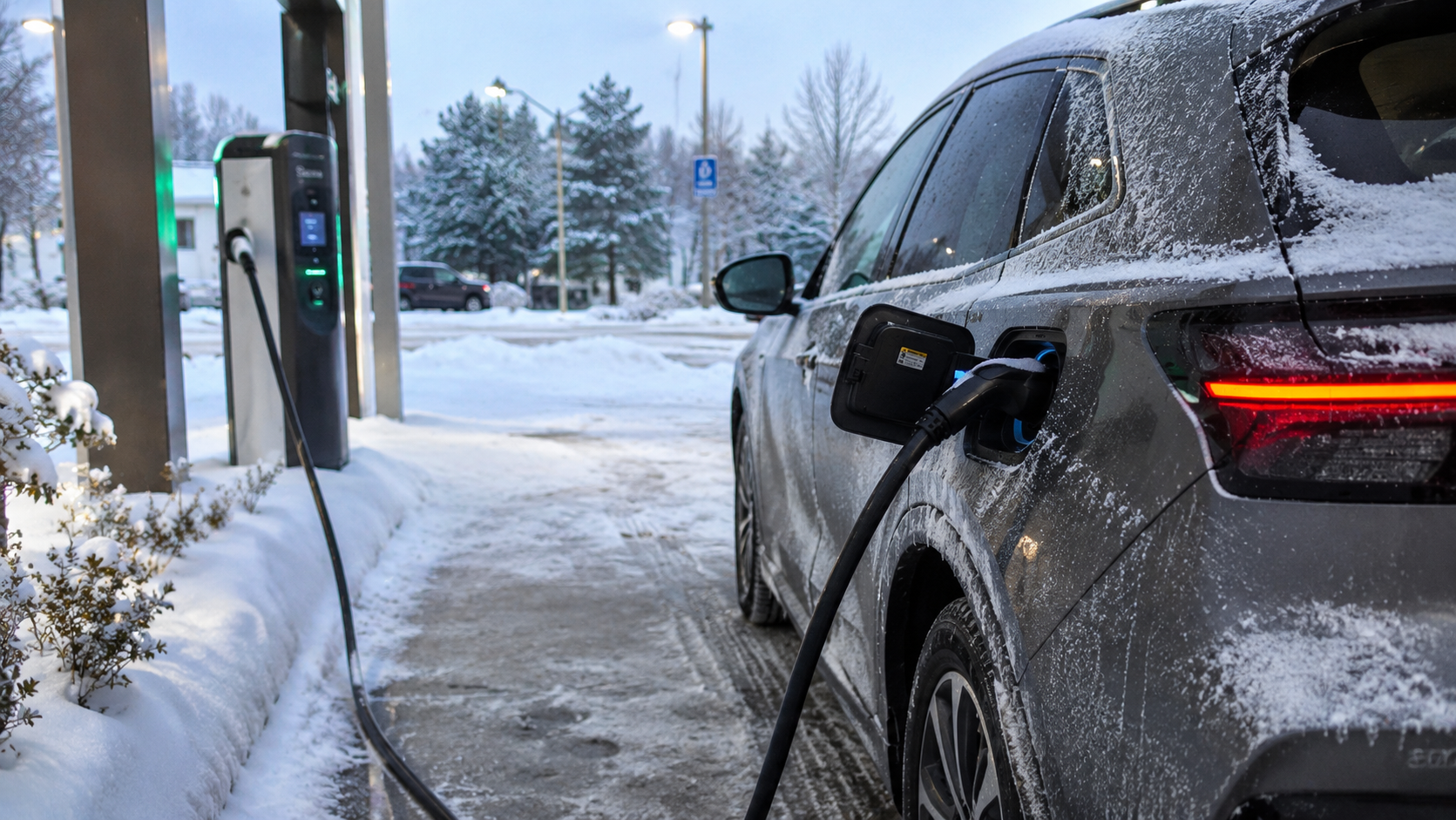



Electric car range in winter can fall substantially as temperatures drop, with a May 2026 AAA study finding an average 39% reduction in calculated driving range at 20°F (−7°C) compared with 75°F (24°C). However, that does not mean every electric vehicle loses 39% of its range whenever the temperature falls below freezing.
Some EVs manage winter conditions significantly better than others. Battery temperature, cabin heating, vehicle speed, trip length, tire choice, and thermal management all influence how far an electric car travels on a charge.
The difference becomes particularly important as the 2026–2027 winter approaches. A vehicle that comfortably completes a 200-mile trip in mild weather may need an additional charging stop in freezing conditions. Drivers who rely on public fast charging can also face higher operating costs and longer charging sessions.
The good news is that much of the seasonal range reduction is temporary. Preconditioning the battery, using efficient heating, maintaining appropriate tire pressure, and planning charging stops can improve winter efficiency without sacrificing safety.
Understanding what the newest tests actually measure is the first step toward making realistic winter driving plans.
How Much Electric Car Range Is Lost in Winter 2026?
Electric cars can lose roughly 10–40% or more of their usable driving range under different winter conditions, although the actual reduction varies substantially by vehicle and testing method.
AAA's May 2026 research provides one of the clearest recent laboratory comparisons. At 20°F (−7°C), the three tested battery-electric vehicles experienced an average 39% reduction in calculated range compared with testing at 75°F (24°C).
The study also found a 35.6% reduction in energy efficiency measured in MPGe. These are related but distinct measurements, so the percentages should not be used interchangeably.
What the AAA 2026 EV Range Study Actually Found
AAA tested three electric vehicles and three hybrid vehicles using controlled laboratory conditions. The test temperatures were 20°F, 75°F, and 95°F (approximately −7°C, 24°C, and 35°C), with the vehicles' cabin climate systems set to 72°F (22°C).
The researchers used a chassis dynamometer and standardized testing cycles. This helped isolate the effects of temperature and climate-control demands rather than relying on varying road conditions.
The results demonstrate how dramatically the same category of vehicle can behave under different temperatures.
| Outside temperature | EV efficiency change | EV range change |
| 75°F (24°C) | Baseline | Baseline |
| 95°F (35°C) | −10.4% | −8.5% |
| 20°F (−7°C) | −35.6% | −39.0% |
The percentages are group results from three tested EVs, not universal predictions for every electric car. They also describe comparisons with the study's moderate-temperature baseline rather than a direct comparison with every vehicle's EPA or WLTP rating.
The key finding is that cold conditions had a considerably larger effect on driving range than the hot conditions tested.
What Does a 39% Winter Range Loss Look Like in Miles?
A 39% reduction means a car retains approximately 61% of the driving distance it would achieve under the comparison conditions.
For example, an EV that could travel 300 miles at the moderate-temperature baseline would cover approximately 183 miles after an equivalent 39% reduction.
This is a mathematical illustration, not a prediction for a particular model or its EPA-rated range.
| Range reduction | Remaining range | Miles lost |
| 10% | 270 miles | 30 miles |
| 20% | 240 miles | 60 miles |
| 30% | 210 miles | 90 miles |
| 39% | 183 miles | 117 miles |
| 45% | 165 miles | 135 miles |
The practical impact becomes clear when planning a winter road trip. Losing 60 miles may be manageable with one planned stop, while losing more than 100 miles can require an entirely different charging strategy.
These figures should not be applied blindly to a vehicle's advertised range. A car that normally falls short of its official rating on the highway may have even less winter range than a simple percentage calculation suggests.
Do All Electric Cars Lose 39% of Their Range Below Freezing?
No. Electric car range in winter varies by model, temperature, driving conditions, and how the vehicle manages battery and cabin heating.
A separate analysis of more than 30,000 electric vehicles published by Recurrent in November 2025 found that 34 EV models retained approximately 78% of their ideal-condition range at 32°F (0°C).
At 20°F (−7°C), the vehicles retained approximately 70% of their ideal-condition range on average.
That corresponds to reductions of around 22% and 30%, respectively, under the study's measurement approach.
These results do not contradict AAA's 39% finding. The studies used different vehicles, conditions, data sources, and comparison methods.
A 39% reduction under one standardized laboratory test and a 30% reduction in a separate real-world dataset can both accurately describe the vehicles and circumstances evaluated.
Which Electric Cars Lose the Most Range in Cold Weather?
Electric cars differ considerably in winter performance. Battery chemistry, heat pumps, thermal-management software, vehicle size, aerodynamics, and powertrain efficiency all affect results.
A useful real-world comparison comes from the Canadian Automobile Association's winter EV testing, which measured how far vehicles traveled in subzero temperatures.
The test involved a route between Ottawa and Mont-Tremblant, combining highway and secondary-road driving.
Across the tested vehicles, actual winter driving distances were 14–39% below their official Natural Resources Canada range ratings.
Real-World Winter EV Range by Model
The results provide examples of how different electric vehicles perform during the same general winter testing program.
| Electric vehicle | Official range | Winter test distance | Difference |
| Chevrolet Silverado EV | 450 mi (724 km) | 283 mi (456 km) | −14%* |
| Polestar 2 | 276 mi (444 km) | 239 mi (384 km) | −14% |
| Volkswagen ID.4 | 263 mi (423 km) | 210 mi (338 km) | −20% |
| Kia EV9 | 270 mi (435 km) | 217 mi (349 km) | −20% |
| Tesla Model 3 | 363 mi (584 km) | 255 mi (410 km) | −30% |
| Hyundai Ioniq 5 | 255 mi (410 km) | 163 mi (262 km) | −36% |
| Toyota bZ4X | 252 mi (406 km) | 158 mi (255 km) | −37% |
| Volvo XC40 Recharge | 254 mi (409 km) | 154 mi (248 km) | −39% |
The Chevrolet Silverado EV began the test at less than 100% charge, so its results were adjusted by the testing organization. Mile figures are rounded conversions from the published kilometer measurements.
These figures come from a road test comparing actual winter distances with Canadian official ratings, not from the AAA laboratory study. The vehicles' versions, batteries, tires, software, and environmental conditions also matter.
A model's position in one winter test should not be treated as a permanent ranking of the best and worst electric cars.
The results nevertheless demonstrate why two vehicles with similar official range figures can behave differently during winter.
For additional background on one of the tested models, the TechnoNews Hyundai Ioniq 5 review covers its battery configurations, charging capabilities, and performance characteristics.
Does a Larger Battery Guarantee Better Winter Range?
A larger battery generally provides more available energy, but it does not guarantee better efficiency or a smaller percentage loss in cold weather.
A large electric pickup may travel farther on a full charge than a compact electric car while consuming significantly more energy per mile.
Vehicle weight, frontal area, tire resistance, heating demands, and driving speed all influence the relationship between battery capacity and range.
For winter road trips, both absolute driving distance and energy consumption matter. A larger battery may reduce the number of stops, but it can also take longer or cost more to replenish depending on charging capability.
Why the Same EV Can Have Different Winter Range Each Day
Electric car range in winter can change even when the outside temperature appears similar.
A short city trip with repeated cabin heating may be less efficient than one continuous drive. On another day, strong headwinds, wet roads, or higher highway speeds may consume additional energy.
Preconditioning, parking conditions, tire pressures, and the battery's starting temperature can also affect the result.
The range achieved on a winter morning should therefore be treated as a useful observation rather than a fixed limit for the entire season.
Why Does Electric Car Range Drop in Cold Weather?
Electric car range decreases in cold weather primarily because the battery operates less efficiently at low temperatures and additional energy is required to heat the cabin and manage battery temperature.
Unlike a gasoline vehicle, an electric car does not have a large supply of waste engine heat that can be redirected into the passenger compartment.
Heating must instead come from electrical systems, such as resistance heaters or heat pumps.
1. Cold Batteries Cannot Deliver Energy as Efficiently
Lithium-ion batteries rely on chemical reactions and the movement of ions between electrodes.
At lower temperatures, internal resistance increases and electrochemical processes slow down. This can reduce available power, regenerative braking capability, and charging performance.
The battery-management system may also limit access to part of the stored energy until the battery warms.
This does not necessarily mean the battery has permanently lost that capacity. Some energy that appears unavailable when cold can become accessible as the temperature increases.
2. Cabin Heating Uses Energy That Could Otherwise Move the Car
Keeping passengers comfortable requires electricity, particularly when outside temperatures fall well below freezing.
An electric resistance heater converts electrical energy into heat. A heat pump can move heat more efficiently under suitable conditions, reducing the amount of electricity needed.
Heating the entire cabin repeatedly during short trips can consume a meaningful share of the available battery energy.
The effect is particularly noticeable when the drive itself requires relatively little energy.
3. Battery Heating Adds Another Energy Demand
Many modern EVs actively warm their high-voltage batteries to maintain appropriate operating and charging conditions.
This protects performance and helps the battery-management system control charging safely.
However, the heating process consumes electricity.
A vehicle parked outside overnight may therefore require energy to warm both its battery and passenger compartment before or during the first drive.
4. Winter Roads Increase Rolling Resistance
Snow, slush, standing water, and certain road surfaces increase the resistance a vehicle must overcome.
Winter tires can also have different rolling-resistance characteristics from summer tires, although their safety benefits in appropriate winter conditions are more important than a small efficiency difference.
Cold weather also reduces tire pressure, which can increase rolling resistance if the tires are underinflated.
The combined effect can reduce winter EV range beyond the losses caused by battery and cabin temperature alone.
5. Highway Driving and Wind Can Magnify Energy Use
Driving faster increases aerodynamic drag and generally raises energy consumption.
A strong headwind adds to the effective airflow speed experienced by the vehicle. Maintaining high highway speeds in cold, windy conditions can therefore shorten the distance available between charging stops.
The precise relationship depends on the vehicle and journey. Temperature-related heating losses may represent a larger share of total consumption during slow city driving, while aerodynamic losses become more significant at higher speeds.
For long winter trips, slowing down moderately can sometimes have a meaningful effect on how far an EV travels.
Does Cold Weather Permanently Damage an EV Battery?
Normal seasonal winter range loss does not automatically mean permanent battery degradation.
A battery may deliver less usable energy or power while cold and return closer to its ordinary performance when temperatures become moderate again.
Permanent battery degradation is a separate process involving long-term changes in battery chemistry and usable capacity.
Temporary Winter Range Loss vs. Battery Degradation
The distinction matters because a driver may see a noticeably lower estimated range in January than in September.
| Characteristic | Temporary winter loss | Battery degradation |
| Primary cause | Temperature and additional energy demand | Long-term chemical and physical changes |
| Often improves when temperatures rise | Yes | No |
| Can affect charging speed | Yes | Sometimes |
| Can affect available power | Yes | Sometimes |
| Indicates permanent damage by itself | No | Yes, if capacity loss is confirmed |
| Main response | Improve winter operation | Assess battery health and warranty |
A change in the range estimate alone is not enough to diagnose battery degradation.
Driving history, temperature, battery-management calculations, and current consumption can all change the number displayed on the dashboard.
Can Charging a Very Cold Battery Cause Damage?
Charging lithium-ion batteries at temperatures outside their safe operating limits can create risks, including lithium plating under certain conditions.
Modern EV battery-management systems are designed to restrict charging power or manage temperature to reduce those risks.
Drivers should not attempt to bypass these protections or force charging when the vehicle reports a battery-temperature problem.
A cold EV taking longer to charge is often operating as designed rather than malfunctioning.
How to Improve Electric Car Range in Winter – 10 Practical Tips
The most effective ways to improve electric car range in winter are to precondition while plugged in, reduce unnecessary heating demand, drive efficiently, and plan charging around battery temperature.
Not every technique produces the same savings on every vehicle. Combining several small changes is generally more effective than relying on one feature.
1. Precondition the Cabin While the Car Is Plugged In
Preconditioning warms the passenger compartment before departure and, on some models, also prepares the battery.
When the vehicle is connected to an appropriate charger, much of the energy needed for heating can come from the electricity supply rather than the battery's stored driving energy.
The US Department of Energy specifically recommends preconditioning while connected to power when the vehicle supports it.
This is especially useful for a predictable morning commute. Scheduled departure features allow the car to prepare itself before the driver gets in.
Preconditioning can improve comfort and reduce the energy required after departure, but it does not create free energy. Electricity is still consumed, and the benefit depends on the vehicle and circumstances.
2. Use Heated Seats and the Heated Steering Wheel
Heated seats and steering wheels can warm occupants using less electricity than heating the entire cabin to a higher temperature.
A moderate cabin temperature combined with seat heating may therefore reduce energy consumption.
However, heating settings should never compromise visibility, windshield defogging, or passenger safety.
The goal is comfortable, efficient heating rather than driving in an unsafe or uncomfortably cold vehicle.
3. Keep Tire Pressure Within Manufacturer Specifications
Tire pressure commonly falls as the weather becomes colder.
Underinflated tires can increase rolling resistance, reduce efficiency, and negatively affect handling.
Check pressures when the tires are cold and follow the vehicle manufacturer's recommended values, usually listed on the driver's door-jamb placard.
Do not inflate tires beyond the recommended pressure simply to chase extra range.
4. Drive Smoothly and Avoid Unnecessary High Speeds
Smooth acceleration and a steady speed can reduce energy demand compared with repeated hard acceleration and braking.
On the highway, maintaining a reasonable speed is often more useful than making frequent changes in cabin temperature.
Reducing speed must always remain consistent with road conditions, visibility, traffic flow, and legal requirements.
The biggest practical gains may come from avoiding inefficient driving rather than trying to minimize every accessory's electricity use.
5. Remove Unnecessary Cargo and Roof Accessories
Extra weight increases the energy required for acceleration and can affect total consumption.
Roof boxes and some external accessories also increase aerodynamic drag, especially at highway speeds.
Removing a roof box when it is not needed can help preserve range during a long trip.
The benefit varies by vehicle, speed, wind, and the accessory's design.
6. Use Eco Mode When Appropriate
Many electric cars offer an Eco driving mode that modifies accelerator response, climate-control behavior, or other systems to reduce energy consumption.
The actual effect differs between manufacturers.
Eco mode may help during normal winter driving, but it should not compromise windshield clearing or the power needed to maintain safe control.
7. Keep the Car Plugged In When Practical
Some EVs manage battery temperature more conveniently while connected to a compatible charging source.
This can reduce the need to draw energy from the battery for certain preconditioning functions.
However, the optimal charging schedule and state-of-charge limit depend on the battery chemistry and the manufacturer's recommendations.
Remaining plugged in does not necessarily mean continuously charging to 100%.
8. Plan Charging Before the Battery Gets Too Low
Winter road trips require more conservative charging decisions than similar journeys in mild conditions.
A route that appears comfortable at the start may become less practical if temperatures fall, traffic slows, or a charging station is unavailable.
Planning an alternative charger and maintaining a reasonable energy reserve can prevent an inconvenient low-battery situation.
9. Choose Parking That Reduces Extreme Cold Exposure
Covered parking or a suitable garage can reduce exposure to frost, snow, wind, and very low temperatures.
The effect depends on the actual conditions in the parking area.
Even an unheated garage may offer some protection from overnight weather, while a warmer location can reduce the initial battery and cabin heating demand.
Charging equipment and cables must still be used according to their electrical and environmental specifications.
10. Keep the Vehicle's Software Updated
Vehicle software can influence energy management, charging behavior, navigation, and battery conditioning.
Manufacturers occasionally improve these functions through updates.
However, a software update does not guarantee a measurable winter range increase.
Install official updates according to manufacturer instructions and review any changes affecting charging or battery operation.
These techniques are most useful when combined with realistic range expectations. Safety, visibility, traction, and passenger comfort must always take priority over obtaining the highest possible mileage.
Does a Heat Pump Make Electric Cars Better in Winter?
A heat pump can reduce the electricity needed to warm an electric car, making it particularly valuable in cold climates. However, its effectiveness depends on temperature, system design, and the vehicle's heating requirements.
Unlike a simple resistance heater, a heat pump transfers heat rather than relying entirely on electrical resistance to produce it.
This can help preserve winter EV range when significant cabin heating is required.
How Much Range Can a Heat Pump Save?
There is no universal percentage that applies to every electric car.
The 2025–2026 Recurrent analysis associated heat-pump technology with approximately 10% more retained range at 32°F (0°C) in its dataset.
That does not mean installing a heat pump automatically adds 10% to every vehicle's winter range.
The difference depends on system efficiency, outside temperature, cabin settings, and how battery thermal management is integrated.
Heat pumps can also become less effective in severe cold, when some vehicles rely more heavily on resistance heating.
Is an EV Without a Heat Pump Bad for Winter Driving?
No. Electric vehicles without heat pumps can still operate successfully during winter.
However, they may use more energy for cabin heating, particularly in conditions where a well-designed heat pump would operate efficiently.
Battery size, thermal management, software, and overall vehicle efficiency also matter.
When comparing models for cold-weather use, examine the complete heating system rather than treating the presence of a heat pump as the only important feature.
The TechnoNews Audi Q6 e-tron review provides additional information about one modern electric SUV's battery and charging technology, although exact winter performance must still be evaluated separately.
Why Does EV Fast Charging Take Longer in Winter?
DC fast charging can slow substantially in cold weather because the battery-management system limits charging power until the battery reaches a suitable temperature.
A charger capable of delivering 150 kW or 350 kW does not guarantee that the vehicle will accept that amount of power.
The car's battery temperature, state of charge, charging curve, and maximum supported input all influence the result.
Why a Cold EV Battery Charges Slowly
When a lithium-ion battery is very cold, accepting energy at a high rate can create chemical and thermal stresses.
The vehicle therefore may reduce charging current.
As the battery warms, charging power can increase if the state of charge and other conditions permit.
This explains why a vehicle might initially charge slowly despite being connected to a powerful public station.
What Is Battery Preconditioning Before Fast Charging?
Battery preconditioning brings the battery closer to a temperature suitable for efficient charging.
On supported vehicles, selecting a compatible fast charger in the built-in navigation system may automatically start this process before arrival.
Tesla documents this behavior for supported Supercharger navigation, while Hyundai provides battery-conditioning functions on equipped models that can operate manually or through navigation.
Preconditioning may consume some battery energy before reaching the charger, but it can reduce charging time.
Battery preconditioning for fast charging is not always the same as warming the cabin before departure. The two functions may operate independently or use different controls.
Should You Charge to 100% During Winter Road Trips?
Charging to 100% can be appropriate for certain journeys when the manufacturer permits it, but it is not automatically the fastest or most efficient strategy.
Many EVs reduce charging power at high states of charge, particularly above approximately 80%.
On a route with reliable charging infrastructure, two shorter charging stops may sometimes take less total time than one session that continues to 100%.
However, freezing weather, limited charger availability, and long distances between stations may justify departing with a higher charge.
Daily charge limits should follow the specific vehicle's battery recommendations, especially because lithium iron phosphate and other lithium-ion battery configurations can have different guidance.
How Much More Does It Cost to Charge an EV in Winter?
Winter increases EV operating costs when the vehicle uses more electricity to travel the same distance.
The impact depends on the electricity tariff, charger type, vehicle efficiency, and charging losses.
AAA's 2026 study found that cold-weather operation at 20°F increased calculated EV operating costs compared with moderate-temperature conditions.
AAA 2026 EV Winter Charging Cost Results
AAA calculated costs using US national average energy prices as of March 27, 2026.
| Temperature | Extra cost using home electricity | Extra cost using public charging |
| 20°F (−7°C) | $32.11 per 1,000 miles | $76.93 per 1,000 miles |
| 95°F (35°C) | $6.78 per 1,000 miles | $16.25 per 1,000 miles |
These numbers represent the calculated increase compared with the study's moderate-temperature conditions, not the total charging bill.
They are also specific to the study's energy-price assumptions and tested vehicles.
A driver charging at home in Ukraine, Germany, the UK, or another market may face very different tariffs.
How to Calculate Your Own Winter EV Charging Costs
The most useful comparison is the electricity consumed per 100 miles or 100 kilometers under ordinary and cold-weather conditions.
Suppose an electric car normally consumes 28 kWh per 100 miles but averages 36 kWh per 100 miles during a winter journey.
That represents an additional 8 kWh per 100 miles.
At a hypothetical home electricity rate of $0.18 per kWh, the extra energy costs approximately $1.44 per 100 miles, before accounting for charging losses.
At a hypothetical public charging rate of $0.50 per kWh, the extra energy costs $4.00 per 100 miles.
| Measurement | Mild weather | Winter |
| Consumption | 28 kWh/100 mi | 36 kWh/100 mi |
| Energy price | $0.18/kWh | $0.18/kWh |
| Energy cost per 100 miles | $5.04 | $6.48 |
| Cost at $0.50/kWh | $14.00 | $18.00 |
These are illustrative calculations, not observed consumption for a particular EV. Real wall-to-battery charging losses, fixed fees, and charger pricing may increase the final cost.
For a driver who covers 1,000 miles per month, even a modest difference in energy consumption can become noticeable across the winter season.
Are Electric Cars Still Cheaper Than Hybrids in Winter?
Electric cars can remain economical in winter, especially when charged at favorable home electricity rates. However, public charging prices can change the comparison substantially.
AAA's May 2026 study also tested three hybrids.
At 20°F, the tested hybrids experienced a 22.8% reduction in fuel economy compared with the 75°F baseline.
Under the study's pricing assumptions, EVs charged at home cost $36.19 less per 1,000 miles than the hybrids in cold conditions. EVs using public charging cost $86.26 more per 1,000 miles.
These findings demonstrate that how an EV is charged can matter as much as winter efficiency when comparing running costs.
For background on another electrified powertrain, the TechnoNews Lexus RX Hybrid overview explains the characteristics of a conventional hybrid SUV.
How to Plan a Winter EV Road Trip Without Running Out of Range
A winter EV road trip should be planned using realistic energy consumption, current weather conditions, and reliable charging options rather than the vehicle's official maximum range alone.
The greatest risk comes from assuming the car will travel as far as it did during mild weather.
A reasonable reserve allows for unexpected delays, changes in weather, closed charging stations, and increased heating needs.
Example of a 160-Mile Winter Drive
Consider an electric car that normally travels 240 miles under the driver's typical moderate-temperature conditions.
If winter reduces that range by 20%, the expected distance falls to approximately 192 miles.
A 160-mile journey might still be possible, but the remaining margin would be only 32 miles.
If the same vehicle experienced a 39% reduction, the calculated range would fall to approximately 146 miles.
The original plan would no longer be practical without charging.
This example illustrates why planning a charging stop in advance is safer than relying on the maximum distance displayed at departure.
How Much Battery Reserve Should You Keep in Winter?
There is no universal state-of-charge reserve suitable for every EV or journey.
A commonly useful planning approach is to aim to arrive at a charger with approximately 15–20% remaining, while adjusting the buffer for weather, terrain, traffic, and charger reliability.
For remote routes or severe conditions, a larger reserve may be appropriate.
A planning target is not a guarantee. The car's actual consumption and the availability of charging infrastructure remain decisive.
What to Check Before a Long Winter Trip
A winter road trip becomes easier when the driver prepares both the vehicle and the charging route.
The most important checks cover the following areas.
- Review the weather forecast. Check temperature, snowfall, wind, and road conditions along the entire route.
- Start with an appropriate charge level. Follow the manufacturer's recommendations and the journey's energy requirements.
- Precondition the vehicle. Warm the cabin and battery while connected to suitable power when supported.
- Check tire pressure and condition. Use appropriate winter tires where required or advisable.
- Identify reliable charging stops. Confirm connector compatibility, station availability, and payment requirements.
- Plan alternative chargers. Avoid depending on a single station in an unfamiliar area.
- Use the vehicle's navigation and energy predictions. Update the plan if actual consumption exceeds expectations.
- Carry winter essentials. Include suitable warm clothing, communication equipment, and basic emergency supplies.
These measures improve resilience when conditions change. An efficient route is useful, but maintaining safe traction, visibility, and passenger comfort remains more important than maximizing mileage.
Electric Car Range in Winter for City Driving vs. Highway Trips
Electric car range in winter can be affected differently in urban traffic and on long highway journeys.
City driving usually involves lower aerodynamic losses, but short journeys can make cabin and battery heating account for a larger share of the energy consumed.
Highway driving avoids repeated stops but often requires more energy to overcome aerodynamic resistance.
Why Short Winter Trips Can Be Inefficient
An EV parked outdoors overnight may need energy to warm its cabin and battery before reaching normal operating conditions.
On a five-mile trip, that initial energy demand can represent a large proportion of total consumption.
If the vehicle cools down again before the next journey, the heating cycle may repeat.
For drivers making multiple short trips, combining errands into one longer outing may reduce repeated warm-up demands.
Why Winter Highway Range Can Be Lower Than Expected
Highway driving is particularly sensitive to vehicle speed and headwinds.
Cold temperatures add heating demands, while wet pavement, winter tires, and additional cargo may further increase consumption.
An EV that performs well during moderate-speed city driving may therefore cover noticeably fewer miles when traveling at sustained highway speeds in freezing weather.
For route planning, recent highway consumption is often more useful than the vehicle's optimistic maximum-range display.
Why the EV Range Estimate Changes Suddenly in Winter
The range displayed on an electric car's dashboard is an estimate, not a precise measurement of how many miles the vehicle will travel.
Different manufacturers calculate estimated range using combinations of battery state of charge, rated efficiency, recent consumption, route conditions, temperature, and driving behavior.
Some dashboards display a relatively stable rated range, while others adjust more aggressively based on current conditions.
Why Your EV Shows Less Range After a Cold Night
A vehicle parked in freezing weather may show a lower range estimate because the battery-management system anticipates reduced efficiency or temporarily limited available energy.
It may also calculate that additional electricity will be needed for heating.
If the battery warms during driving, some limitations may ease.
However, warmer battery operation does not guarantee that the dashboard will return to the same estimate immediately.
Does Losing Estimated Miles Mean the Battery Is Failing?
Not necessarily. A sudden reduction in displayed range can be caused by normal cold-weather operation rather than a permanent loss of capacity.
However, an unusually large unexplained reduction, persistent battery warning, or inability to charge normally deserves investigation.
Check the vehicle's energy-consumption information, recent driving conditions, and current battery alerts.
If the problem persists under moderate temperatures or the vehicle reports a fault, follow the manufacturer's diagnostic and service guidance.
What Happens to Regenerative Braking in Cold Weather?
Regenerative braking can be reduced when an EV battery is cold or nearly fully charged.
During regeneration, the electric motor acts as a generator and sends energy back into the battery.
If the battery cannot safely accept energy at the normal rate, the vehicle may limit regeneration.
Why an EV May Not Slow Down as Strongly in Winter
A driver accustomed to strong one-pedal braking may notice different deceleration behavior on a freezing morning.
Some vehicles indicate reduced regenerative braking through dashboard icons or messages.
The level of available regeneration may increase as the battery warms.
Never assume one-pedal driving will provide the same deceleration in every temperature or battery condition. Remain prepared to use the friction brakes as needed.
Regenerative braking is also not a substitute for appropriate braking technique on snow or ice.
What to Do if Your EV Charge Port Freezes
A frozen charging connector or charge-port latch can prevent a cable from being inserted, locked, or removed normally.
This is a practical winter problem in areas experiencing freezing rain, wet snow, or repeated thaw-and-freeze cycles.
The safest response is to use the manufacturer's approved defrosting procedure.
How to Deal With a Frozen Charging Connector
If the connector is stuck, stop any active charging session according to the vehicle's instructions before attempting removal.
Many EVs provide a charge-port heater, defrost setting, or other specific procedure.
Tesla, for example, documents the use of its vehicle defrosting functions to help free a frozen charge-port latch.
Do not force the connector, strike the charge port, or pour boiling water over the electrical connection.
If the problem persists, consult the vehicle manual or qualified service support.
How to Prevent Charging Problems During Snow and Ice
Keep the connector and charging equipment clean and follow the manufacturer's storage recommendations.
A compatible protective cover may help reduce ice accumulation when the vehicle is parked outdoors.
Never use improvised coverings that trap moisture, interfere with the connector, or prevent safe charging.
Outdoor charging equipment must also be suitable for the relevant weather conditions and installed correctly.
Is Electric Car Range in Winter Different in the US, UK, EU, and Ukraine?
The physical effects of cold weather apply across markets, but winter-range expectations and charging costs differ because climates, vehicle specifications, range-rating systems, and infrastructure vary.
A vehicle rated for a particular distance in the US may have a different published figure in Europe.
Understanding the measurement system prevents misleading comparisons.
EPA vs. WLTP – Why Official EV Range Figures Differ
The US Environmental Protection Agency uses EPA testing procedures to determine official vehicle efficiency and range labels for the American market.
European vehicles typically use the Worldwide Harmonized Light Vehicles Test Procedure, or WLTP.
The test cycles and measurement procedures differ. WLTP figures are often higher than comparable US EPA ratings for certain models, but the difference is not a fixed percentage.
Neither rating guarantees the same distance during freezing highway driving.
For international comparisons, make sure the vehicle configuration, battery size, tires, and rating system are consistent.
Winter EV Driving in Ukraine
Ukrainian EV drivers may face a combination of freezing temperatures, variable road conditions, and electricity interruptions.
In addition to planning for reduced winter range, it is important to consider whether home charging will be available during the expected parking period.
A vehicle's ability to charge overnight may depend on the building's electrical supply and the available charging equipment.
Charging through household outlets requires suitable wiring, protective devices, grounding, and approved EV charging equipment. Improvised extensions or unsafe connections should never be used to compensate for limited charging infrastructure.
For longer trips, identifying several reliable public charging options can provide an additional margin of safety when electricity availability changes.
Winter EV Driving in the UK and Europe
Drivers in the UK and across Europe should account for the difference between WLTP range and actual winter consumption.
For example, a vehicle advertised with 300 miles of WLTP range may not cover 300 miles during sustained motorway driving in freezing conditions.
Charging connector standards, public charging prices, payment methods, and access arrangements also vary by country.
The vehicle's specific connector and available charging networks should be checked before international winter trips.
8 Common Mistakes That Reduce Electric Car Range in Winter
Many winter EV range problems result from unrealistic expectations or avoidable operating habits rather than a fundamental problem with the battery.
The most common mistakes involve heating, charging, and route planning.
- Expecting the advertised range in freezing weather. Official ratings are not guarantees for every temperature, speed, or road condition.
- Skipping preconditioning when it is available. Heating the cabin and battery while plugged in can reduce the battery energy used after departure.
- Driving with underinflated tires. Low tire pressure can increase energy consumption and negatively affect handling.
- Relying on one public charger. A faulty or unavailable charging station can leave insufficient options when the range margin is already small.
- Assuming a high-power charger guarantees fast charging. A cold battery may accept less power regardless of the station's advertised output.
- Using a fixed 80% or 100% charging rule for every EV. Charging guidance varies by battery chemistry, manufacturer, and travel requirements.
- Confusing temporary range loss with battery degradation. Cold-weather limitations do not automatically indicate permanent capacity damage.
- Sacrificing safety to save electricity. Reducing windshield heating, using unsuitable tires, or driving without adequate visibility is never justified by a few extra miles.
The strongest winter driving habits focus on predictable energy use and safe margins. A small efficiency improvement has little value if it creates a safety problem or increases the risk of becoming stranded.
Is an Electric Car Worth Owning in a Cold Climate in 2026?
Electric cars can remain practical in cold climates when their winter driving range meets the owner's needs and suitable charging is available.
Daily commutes may require far less energy than the battery can store, even after a substantial seasonal reduction.
The biggest challenges often arise during long-distance travel, frequent use of expensive public chargers, or ownership without dependable charging access.
When an EV Makes Sense for Winter Commuting
An EV can be a convenient winter commuter when the daily journey is comfortably within the vehicle's reduced cold-weather range.
Access to dependable charging at home or work makes winter operation easier.
A driver traveling 20–40 miles daily may have substantial flexibility with many modern EVs, although the precise margin depends on the vehicle and conditions.
When Winter Range Should Influence an EV Purchase
Cold-weather performance deserves greater attention when the car regularly travels long distances, operates in severe cold, or cannot be charged conveniently.
Compare real-world winter data, thermal-management features, charging curves, and local infrastructure.
A heat pump, effective battery preconditioning, and predictable route planning can be valuable features, but they should be assessed alongside battery capacity and efficiency.
For drivers who rely entirely on public charging, operating costs and charger availability may be as important as the vehicle's rated range.
The Final Verdict on Electric Car Range in Winter 2026
Electric car range in winter can decline sharply, but the size of the reduction is not the same for every EV.
The May 2026 AAA research found an average 39% reduction in calculated driving range at 20°F compared with 75°F under controlled testing conditions. Separate real-world studies demonstrate a broad range of winter results across vehicle models.
Cold batteries, cabin heating, battery thermal management, tires, and driving conditions all contribute to the difference.
Preconditioning while plugged in, maintaining appropriate tire pressure, using efficient cabin heating, and planning reliable charging stops can make winter driving more predictable.
The most important winter EV rule is to plan around realistic consumption rather than maximum advertised range. That approach reduces uncertainty whether the journey involves a short commute, a weekend drive, or a long trip through freezing weather.
Frequently Asked Questions About Electric Car Range in Winter 2026
Electric car range in winter can decrease by roughly 10–40% or more depending on conditions. AAA's May 2026 tests found an average 39% reduction at 20°F compared with 75°F. Individual vehicles may perform better or worse.
Cold batteries operate less efficiently, while cabin heating and battery thermal management consume additional electricity. Snow, slush, tire resistance, and higher-speed driving can further reduce range. The exact impact varies by vehicle and conditions.
Yes, electric car range can decline around 32°F (0°C). Recurrent's 2025–2026 analysis found that 34 models retained approximately 78% of their ideal-condition range at freezing temperatures on average. Individual results varied considerably.
Yes, losses approaching or exceeding 50% are possible under some severe conditions, particularly with short trips, substantial heating demands, or inefficient operation. However, such a reduction is not typical of every EV or every winter journey.
Yes. Tesla vehicles are affected by cold batteries, cabin heating, and driving conditions like other EVs. Their winter performance varies by model and configuration. Battery preconditioning and heat-pump systems can help reduce some of the impact.
Preconditioning can help preserve driving range when the vehicle warms its cabin and battery while connected to a charger. It can also improve battery readiness. The benefit depends on vehicle design, departure timing, and outside temperature.
Yes. Cabin heating consumes electricity that would otherwise be available for driving. Heat pumps can reduce that demand under suitable conditions, while heated seats may provide efficient supplemental warmth. Windshield visibility and passenger safety should never be compromised.
Usually not. Much of the seasonal reduction comes from temporary battery-temperature effects and additional heating energy. Permanent battery degradation is a different process. Persistent unexpected range loss under normal conditions may require battery-health assessment.
Yes. Cold batteries often accept lower charging power until their temperature reaches a suitable range. Battery preconditioning can help, and many EVs reduce charging power at high states of charge regardless of the outside temperature.
Yes, when the vehicle and charging equipment are designed for outdoor use and installed correctly. Connectors should be kept free from excessive ice and contamination. Always follow the manufacturer’s procedures for frozen or damaged charging components.
It depends on the vehicle's battery chemistry, manufacturer guidance, and trip requirements. A higher charge may be useful before a long winter journey, but daily charging limits vary. Charging above 80% can also take considerably longer on DC fast chargers.
They can be. Increased electricity consumption raises the cost per mile, especially when using expensive public chargers. AAA's 2026 study found additional winter EV operating costs compared with moderate-temperature conditions, with the amount depending on charging prices.
There is no universal winner across all conditions. Models with efficient thermal management, effective heating, and sufficient battery capacity can perform well. Compare independent winter tests for the exact model year and configuration before purchasing.
It can be. High speeds and headwinds increase aerodynamic energy demand, while cold weather adds heating loads. However, repeated cabin heating during short urban trips can also reduce efficiency. Actual results depend on speed, route, and temperature.
Start with sufficient charge, use realistic winter consumption figures, precondition where supported, and plan dependable charging stops. Maintain a suitable reserve and identify alternative chargers. Adjust the route if weather or actual energy consumption changes.