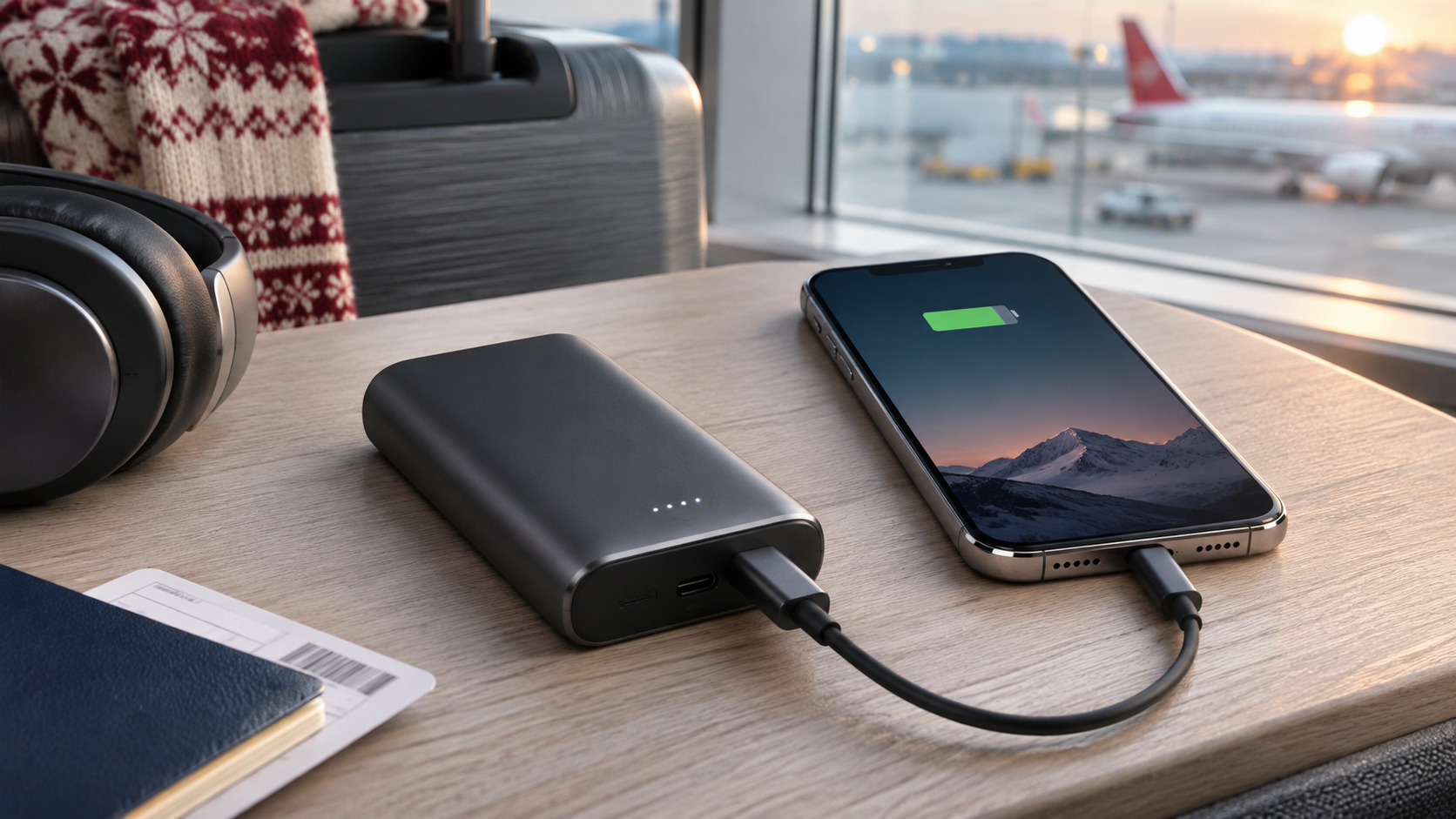


A power bank can be a lifesaver when a flight is delayed, airport outlets are occupied, or a phone battery is running low before boarding. But in 2026, carrying a portable charger on a plane requires more attention than simply making sure it fits in a backpack. New international restrictions and stricter airline policies mean that a charger accepted on a previous trip might no longer meet the rules.
The most important portable charger rules for holiday travel are straightforward: keep power banks in carry-on baggage, choose a battery rated at no more than 100 watt-hours (Wh), and check how many your airline permits. Under international rules introduced on March 27, 2026, passengers are limited to two power banks, while some airlines allow only one.
There is another important change. Recharging a power bank using an aircraft's power supply is prohibited under the updated international provisions, and some airlines also prohibit using power banks to charge phones or other devices during the flight.
With Thanksgiving travel approaching in the United States, followed by Christmas and New Year's trips worldwide, understanding these rules before reaching the airport can prevent unnecessary delays, confiscated equipment, and last-minute packing problems.
Portable Charger Rules for Holiday Travel in 2026 – What Is Allowed?
Most ordinary portable chargers remain permitted on passenger flights in 2026, provided their capacity meets the applicable limits and they travel in the cabin. The restrictions primarily concern battery capacity, quantity, storage, and whether the charger can be used during the flight.
The following comparison covers the most important requirements passengers should check before departure.
| Rule | What travelers need to know |
| Carry-on baggage | Power banks are allowed when they meet applicable airline restrictions |
| Checked baggage | Power banks are prohibited |
| Standard battery capacity | Up to 100 Wh is generally permitted |
| Above 100 Wh | Airline and regulatory restrictions vary; some prohibit these power banks entirely |
| Above 160 Wh | Not permitted as ordinary passenger baggage |
| Maximum quantity | International standard: two power banks per passenger |
| Stricter airline limits | Some carriers permit only one |
| Charging the power bank in flight | Prohibited under the 2026 international provisions |
| Charging a phone with a power bank | Restricted or prohibited depending on the airline |
| Storage during the flight | Keep accessible; many airlines require under-seat storage |
| Damaged or recalled batteries | Must not be packed for ordinary passenger travel |
These are the general considerations, not a substitute for the operating airline's current policy. The strictest applicable rule on an itinerary determines what can actually be carried.
For example, a passenger may have two small chargers that meet the international quantity limit but still encounter problems when boarding an airline that permits only one. Checking the specific carrier is therefore essential.
1. Power Banks Must Stay in Carry-On Baggage
Portable chargers containing lithium batteries must travel in the aircraft cabin rather than in checked luggage. This rule applies to ordinary phone power banks, laptop power banks, and many other external battery packs.
The reason is fire safety. Lithium-ion batteries can experience thermal runaway, a dangerous condition in which a battery overheats and releases heat and gases. If that happens in the cabin, trained crew members can respond more quickly than if the battery is inside the aircraft's cargo hold.
Can You Put a Power Bank in Checked Luggage?
No. Power banks and other spare lithium batteries are prohibited in checked baggage, even when their capacity is below 100 Wh.
A portable charger should be packed in an accessible carry-on bag or personal item. It should also be protected against accidental activation, physical damage, and electrical short circuits.
A charger is not exempt from the rule because it is small, switched off, or completely discharged. A 5,000 mAh battery pack still belongs in the cabin, not in a checked suitcase.
What If Your Carry-On Bag Is Checked at the Gate?
Remove every power bank and spare lithium battery before handing over a carry-on bag for gate checking. This situation is common on crowded holiday flights, particularly when overhead storage fills up.
A gate-checked suitcase travels in the hold, so the same battery restrictions apply as they do to ordinary checked baggage. Keeping the power bank in a separate small pouch makes it easier to remove without unpacking everything.
Before approaching the gate, move chargers into a personal item that will remain with you. Check the airline's instructions for other lithium-powered devices as well, since requirements can differ between installed batteries and spare batteries.
2. The 100 Wh Power Bank Rule Is More Important Than mAh
The safest portable charger choice for international flights is generally a model with a clearly labeled capacity of 100 Wh or less. Watt-hours measure stored energy, while milliamp-hours describe electrical charge and must be considered alongside battery voltage.
This distinction matters because portable chargers are commonly advertised as 10,000 mAh, 20,000 mAh, or 30,000 mAh. Airport battery restrictions, however, usually depend on their watt-hour rating.
How to Convert Power Bank mAh to Wh
Calculate watt-hours by multiplying milliamp-hours by the battery's nominal voltage and dividing by 1,000. The voltage must refer to the internal battery cells rather than an arbitrary USB output rating.
The formula is:
Wh = (mAh × V) ÷ 1,000
For example, a 20,000 mAh power bank rated at a nominal 3.7 volts contains approximately:
20,000 × 3.7 ÷ 1,000 = 74 Wh
This is below the usual 100 Wh threshold. However, manufacturers may use different nominal cell voltages, so the product's actual specifications take priority over an approximate calculation.
Which Power Bank Sizes Can You Take on a Plane?
Common phone chargers in the 5,000–20,000 mAh range generally fall below 100 Wh. Larger units may approach or exceed the threshold, especially when designed for laptops or high-capacity charging.
The following examples assume a nominal battery voltage of 3.7 V. They are calculations, not certifications of specific products.
| Advertised capacity | Approximate energy at 3.7 V | General travel assessment |
| 5,000 mAh | 18.5 Wh | Usually permitted |
| 10,000 mAh | 37 Wh | Usually permitted |
| 15,000 mAh | 55.5 Wh | Usually permitted |
| 20,000 mAh | 74 Wh | Usually permitted |
| 26,800 mAh | 99.16 Wh | Near the limit; verify the label |
| 27,000 mAh | 99.9 Wh | Near the limit; verify the label |
| 30,000 mAh | 111 Wh | May be prohibited as a power bank |
| 40,000 mAh | 148 Wh | Frequently prohibited; do not assume approval is possible |
The table demonstrates why 30,000 mAh chargers deserve extra attention. They may exceed the standard passenger allowance even when they look similar to smaller models.
A 20,000 mAh charger with a clear rating below 100 Wh is generally a simpler travel choice than a model sitting just below the limit. Always confirm the printed Wh value and the airline's actual policy.
Is a 100W Power Bank the Same as a 100 Wh Power Bank?
No. A power bank advertised as 100W describes its charging output, while 100 Wh describes how much energy the battery stores. These measurements represent different properties and should not be confused.
For example, a 20,000 mAh power bank might support 100W USB-C Power Delivery output while storing only 74 Wh of energy. Its high charging wattage does not automatically make it too large for air travel.
Conversely, a device with relatively modest charging output may contain more than 100 Wh of stored energy. Airline battery capacity limits concern Wh, not the maximum USB-C charging wattage.
3. New 2026 Rules Limit How Many Power Banks You Can Carry
International aviation rules introduced on March 27, 2026, established a maximum of two power banks per passenger. The change is especially important for travelers accustomed to packing several portable chargers for phones, tablets, and laptops.
Previously, some guidance treated ordinary low-capacity spare lithium batteries differently, with no equivalent universal two-device limit for small power banks. The 2026 international provisions introduced a distinct quantity restriction for portable charging banks.
Can You Bring Two Power Banks on a Plane?
Generally, yes, under the 2026 international maximum, provided the airline permits two and both devices meet its capacity and safety requirements. However, the rule is not a guarantee that every carrier must accept two chargers.
Southwest Airlines, for example, introduced a one-power-bank-per-passenger policy effective April 20, 2026. Other carriers permit two but impose additional restrictions on storage and use.
Travelers should therefore check the airline rather than assume the international maximum is an automatic entitlement.
Can You Bring Three Small Power Banks Instead of One Large Charger?
Not under the updated two-power-bank international limit. Three small chargers do not become acceptable merely because their combined capacity is below 100 Wh.
The restriction concerns the number of individual power banks as well as their energy ratings. A passenger carrying three 5,000 mAh chargers may therefore exceed the permitted quantity even though each battery is relatively small.
A single reliable 10,000–20,000 mAh charger is often sufficient for ordinary holiday travel. If additional capacity is necessary, verify whether the airline permits a second power bank rather than packing several without checking.
4. Airline Power Bank Rules Are Not Identical in 2026
Airlines can apply stricter restrictions than the general aviation framework, so portable charger rules for holiday travel vary by carrier. Some allow two power banks, others allow only one, and policies on charging devices during flight differ.
This matters for international journeys with connecting flights. A charger accepted on the first airline may be restricted on a later segment operated by another carrier.
Power Bank Rules for American, Southwest, British Airways, Ryanair, and Lufthansa
The following comparison reflects the airlines' published policies checked in November 2026. Airline requirements can change, so the operating carrier's current baggage and dangerous-goods instructions should still be reviewed shortly before departure.
| Airline | Published power bank limit | Maximum standard capacity | Important restriction |
| American Airlines | 2 per passenger | 100 Wh each | Must remain accessible; cannot be recharged onboard |
| Southwest Airlines | 1 per passenger | 100 Wh | No overhead-bin storage; keep visible when in use |
| British Airways | 2 per passenger | 100 Wh each | Under-seat or seat-pocket storage; no onboard recharging |
| Ryanair | 2 per passenger | 100 Wh each | No overhead storage; device charging restricted during taxi, takeoff, and landing |
| Lufthansa Group | 2 per passenger | 100 Wh normally | Using or recharging power banks onboard is prohibited |
These differences are significant enough to affect the packing decision. A traveler with two eligible chargers may comply with American Airlines' published limit but exceed Southwest's one-device allowance.
The Lufthansa Group policy also applies across its group airlines under the stated group-wide restrictions. If an itinerary involves multiple airlines, check the operating carrier for each segment rather than relying only on the company that issued the ticket.
Are Power Banks Over 100 Wh Allowed With Airline Approval?
Some regulatory frameworks and airlines provide an approval process for certain lithium batteries between 100 Wh and 160 Wh. However, approval is not universally available for power banks, and it must not be assumed that a large portable charger qualifies.
The 2026 IATA operator guidance distinguishes power banks from other spare batteries and lists power banks above 100 Wh as prohibited. Meanwhile, some national guidance and airline policies refer to approval procedures for larger batteries or power banks.
This difference makes international travel with a charger exceeding 100 Wh particularly uncertain. A safe approach is to select a properly labeled power bank below the threshold and obtain written confirmation before attempting to carry any larger model.
A rule allowing certain 101–160 Wh laptop or camera batteries does not automatically extend permission to every external battery pack.
Do US, UK, and EU Power Bank Rules Differ?
Yes. The United States, United Kingdom, and European aviation markets generally recognize the distinction between installed lithium batteries and spare batteries, but their published guidance and individual airline policies are not always identical.
In the United States, FAA guidance allows many lithium batteries up to 100 Wh in cabin baggage and discusses airline approval for certain larger spare batteries. Nevertheless, operating airlines may have stricter power bank quantity and capacity restrictions.
In the United Kingdom, the Civil Aviation Authority recognizes the international changes effective March 27, 2026, including the two-power-bank maximum and prohibition on recharging them in flight. European aviation safety guidance also emphasizes carrying spare batteries in hand luggage and checking operator requirements.
For passengers traveling from Ukraine through European airports, the rules of every operating airline and relevant transit country should be reviewed. A connection through a major European hub does not remove restrictions imposed by a later airline.
5. Charging a Phone With a Power Bank During a Flight May Be Prohibited
Carrying a permitted power bank and using it onboard are two separate questions. The updated international requirements prohibit recharging power banks during flights and advise against using them to recharge portable electronic devices.
Some airlines have gone further by banning power bank use entirely during the flight. Others allow limited use under specific conditions and crew instructions.
Can You Charge Your Phone With a Power Bank on a Plane?
It depends on the airline. For example, Lufthansa Group prohibits using power banks to charge devices onboard, while Ryanair permits charging personal electronic devices under certain conditions, excluding taxi, takeoff, and landing.
Travelers should not assume that permission to carry a portable charger also means permission to connect it during the flight. The airline's operating rules and instructions from cabin crew take priority.
The safest plan is to charge essential devices before boarding and treat the power bank primarily as a backup for the airport, layovers, and arrival.
If the airline allows onboard charging, keep the power bank accessible and follow any restrictions concerning its location and use.
Can You Recharge a Power Bank From an Airplane USB Port?
No. The 2026 international provisions prohibit passengers from recharging power banks onboard aircraft.
That includes connecting a portable charger to a seat USB outlet or another aircraft power supply. An available outlet does not imply that recharging an external lithium battery is permitted.
Some aircraft offer seat power for phones, tablets, and laptops. Use those outlets only for permitted devices and follow the airline's instructions regarding compatible chargers and cables.
Why Are Airlines Restricting Power Bank Use?
The restrictions address the risks associated with lithium battery overheating, short circuits, and thermal runaway. A battery incident can develop rapidly, making accessibility and early detection important.
When a power bank is buried in luggage, overheating may be harder to notice. Restrictions on charging and storage help reduce situations in which a battery problem goes undetected.
Passengers should notify cabin crew immediately if a battery becomes unusually hot, swells, emits smoke, or produces an unfamiliar chemical smell. Do not attempt to hide a smoking battery, place it in water without crew direction, or handle an active fire independently.
6. Power Banks Should Be Accessible Throughout the Flight
A portable charger should be packed so it can be found quickly and inspected if necessary. Many airlines now explicitly require power banks to remain under the seat, in a seat pocket, or otherwise within reach rather than in overhead bins.
This approach helps cabin crew respond promptly if a battery shows signs of overheating. It also makes it easier for passengers to comply with requests to disconnect or inspect a device.
Where Should You Store a Power Bank on a Plane?
The most practical place is a small protective pouch inside an under-seat personal item, provided this matches the airline's requirements. The power bank should not be crushed beneath heavy objects or stored beside loose metal items that could cause a short circuit.
A protective case can reduce the risk of scratches, impacts, and accidental contact with exposed terminals. Separate pouches are useful when carrying two permitted chargers.
Follow these packing steps before leaving for the airport:
- Inspect the Power Bank. Check for swelling, cracks, damaged ports, unusual heating, or signs of a product recall.
- Read the Capacity Label. Confirm that the Wh rating is visible or clearly verifiable from manufacturer markings.
- Protect the Connectors. Use a suitable case or pouch and keep exposed contacts away from metal objects.
- Pack It in Cabin Baggage. Do not place the battery in checked luggage.
- Keep It Accessible. Use an under-seat bag or another location permitted by the airline.
- Separate Multiple Batteries. Prevent chargers and loose batteries from rubbing against one another.
- Check the Airline's Storage Policy. Some carriers prohibit storing power banks in overhead compartments altogether.
These steps can help prevent packing problems and make any additional airport inspection easier. They do not replace airline approval when a device exceeds ordinary passenger battery allowances.
Can You Keep a Power Bank in Your Pocket?
Some airlines permit passengers to carry power banks on their person, provided the device is protected and complies with cabin safety instructions. Others specify appropriate storage locations.
A pocket may be convenient for a small charger, but it should not contain loose keys, coins, or other objects that could contact exposed electrical terminals. The charger should also be protected from pressure or accidental activation.
For larger power banks, a dedicated pouch inside an accessible personal item is usually more practical. Always follow the carrier's instructions concerning storage during takeoff and landing.
7. A Damaged or Unlabeled Power Bank May Be Rejected
Even a charger below 100 Wh can become a problem if its condition or specifications cannot be verified. Airlines and airport personnel may reject batteries with visible damage, unreadable capacity information, or safety concerns.
A cracked enclosure, swollen battery, or damaged charging port is more than a cosmetic issue. Lithium batteries in poor condition can present a significant fire hazard.
What If Your Power Bank Has No Wh Label?
Check whether the manufacturer's markings show both capacity and nominal voltage. These values can sometimes establish the watt-hour rating using the standard calculation.
For example, a clearly marked 20,000 mAh battery with a nominal voltage of 3.7 V corresponds to approximately 74 Wh. However, acceptance depends on the relevant airline and screening requirements.
Some airlines insist that capacity information be displayed directly on the charger. Others may consider clearly identifiable manufacturer specifications, but an online listing or handwritten sticker is not guaranteed to satisfy screening staff.
Do not buy an unlabeled power bank for an upcoming international flight. A model with legible factory markings provides a much more reliable basis for inspection.
Can You Fly With a Swollen or Recalled Power Bank?
No. A swollen, damaged, defective, or safety-recalled lithium battery should not be packed for ordinary passenger travel.
Physical swelling may indicate internal battery deterioration. Similarly, unusual heating, a distorted enclosure, or signs of leaking are reasons to stop using the device.
Do not puncture a damaged battery, attempt to flatten it, or place it in a suitcase to avoid inspection. Follow the manufacturer's safety instructions and arrange suitable disposal or professional assessment before traveling.
For smartphones that also show unusual battery behavior, the guide on why a phone battery drains so fast explains how to distinguish normal battery consumption from overheating, aging, and warning signs that require attention.
How to Choose a Travel Power Bank That Meets Airline Rules
A good holiday travel portable charger should provide enough power for the journey without approaching airline capacity limits unnecessarily. For most passengers, a clearly labeled 10,000–20,000 mAh power bank offers a practical balance between portability and available energy.
Capacity is only one consideration. Charging output, connector compatibility, manufacturer reliability, and physical condition also matter.
Is a 10,000 mAh or 20,000 mAh Power Bank Better for Travel?
A 10,000 mAh power bank is usually easier to carry and can provide useful backup charging for a smartphone during a long travel day. A 20,000 mAh model stores approximately twice as much energy at the same nominal voltage, making it more suitable for long layovers or several devices.
The actual number of phone charges depends on the phone's battery, voltage conversion, temperature, cable losses, and charging conditions. A 20,000 mAh rating does not mean that 20,000 mAh will be delivered directly to the phone's battery.
The following comparison can help narrow the choice.
| Travel situation | Practical starting capacity | Main consideration |
| Short flight with a charged phone | 5,000–10,000 mAh | Compact backup power |
| Full day of travel | 10,000 mAh | Reasonable size and portability |
| Long layover or overnight disruption | 20,000 mAh | Greater energy reserve |
| Two phones or several accessories | 20,000 mAh | Multiple ports and adequate output |
| Laptop charging | Up to 100 Wh, if permitted | USB-C PD compatibility and wattage |
| Large off-grid energy needs | Specialized equipment | Passenger airline restrictions may prohibit larger packs |
The ideal size depends on how many devices need charging and how long access to a wall outlet may be unavailable. A larger battery is not automatically more useful if its weight and airline restrictions create additional difficulties.
Can a Laptop Power Bank Go on a Plane?
Yes, provided it meets the applicable battery capacity, quantity, and airline restrictions. Many USB-C laptop power banks are designed to remain below 100 Wh, but some high-capacity models exceed that threshold.
Laptop charging also requires the correct output capability. A portable charger may contain enough stored energy yet lack the USB-C Power Delivery wattage needed to charge a particular laptop effectively.
Before buying, check both the Wh capacity for air travel and the supported USB-C output for device compatibility. These figures solve different problems and should not be treated interchangeably.
What Should You Check Before Buying a Power Bank on Black Friday?
Prioritize clear battery specifications, reliable construction, compatible charging standards, and a trustworthy seller. An inexpensive high-capacity charger is not a bargain if the manufacturer provides unclear safety information or misleading capacity figures.
For Black Friday 2026, which falls on November 27, pay attention to the exact model rather than the advertised discount alone. The price of a larger charger may appear attractive, but a 30,000 mAh model could be unsuitable for a planned flight.
The Black Friday tech buying checklist covers specification checks, warranty considerations, and ways to evaluate technology discounts before purchasing. These checks are particularly useful for chargers and other accessories where product specifications directly affect usability.
A power bank intended for air travel should have clearly identifiable capacity information and appropriate product documentation. Avoid relying on suspiciously high advertised capacities or vague claims about airline approval.
What Happens If Airport Security Rejects Your Power Bank?
An airport or airline may refuse a portable charger that exceeds the applicable limits, lacks verifiable markings, or shows signs of damage. What happens next depends on the screening authority, airport procedures, and how much time remains before departure.
Passengers should not assume that a prohibited power bank can simply be moved into checked baggage. That option is unavailable for ordinary spare lithium battery packs.
Can Airport Security Confiscate a Portable Charger?
A charger may be refused at screening or boarding if it does not meet the applicable requirements. The exact process varies by airport and jurisdiction, and travelers may be required to surrender the item if they cannot arrange an acceptable alternative.
Where practical, an airline representative or security officer may explain what options are available. These could depend on local rules, the battery's condition, and whether a nontraveling companion can take possession of it.
Do not attempt to conceal a prohibited charger or move it into checked luggage after being told it is not permitted. If the battery's classification is uncertain, ask the appropriate staff before proceeding through security.
What If You Have a Connecting Flight on Another Airline?
Check the rules of every airline operating a segment of the itinerary. A traveler who complies with the first carrier's policy may still encounter a stricter limit during a connection.
For example, carrying two 20,000 mAh chargers may be acceptable under one airline's published quantity limit but exceed another carrier's one-power-bank restriction. The transfer airport may also apply its own screening procedures.
The safest approach is to identify the most restrictive requirement across the entire journey before leaving home. This is especially important when purchasing separate tickets or using codeshare services operated by another company.
Are Smart Suitcases and Built-In Charging Bags Allowed?
Smart luggage with an integrated lithium battery may be permitted when the battery is removable and the bag meets the relevant carrier's requirements. The crucial difference is whether the power source can be separated from the suitcase when necessary.
A suitcase with a built-in charging port is not automatically prohibited. However, the internal battery must comply with the applicable restrictions, and some airlines will reject bags with non-removable batteries above narrowly defined limits.
Do You Have to Remove a Smart Suitcase Battery?
If the suitcase is checked, a removable lithium battery normally must be taken out and carried in the cabin. The battery then follows the relevant spare-battery or power-bank rules.
For cabin baggage, airline requirements vary according to battery type, energy rating, and accessibility. Some carriers require removal in particular circumstances even when the suitcase remains in the cabin.
A suitcase with a non-removable battery may be refused if it exceeds the permitted exception. Check the luggage manufacturer's specifications and the operating airline's smart baggage policy before traveling.
Do AirTags and Luggage Trackers Count as Power Banks?
Ordinary luggage trackers are not the same as portable charging banks, so their classification and requirements can differ. Small tracking devices generally contain much less energy than a phone power bank.
However, checked baggage containing a tracker still needs to comply with relevant battery safety rules. The allowance for a small installed tracking battery should not be confused with permission to place an ordinary portable charger in checked luggage.
If the tracker uses a replaceable lithium cell, ensure it is securely installed and protected from damage. For unusual smart luggage systems, confirm the airline's requirements instead of relying on the general rules for small trackers.
How to Keep Your Phone Charged When Power Bank Use Is Restricted
A flight that prohibits power bank use does not necessarily leave passengers without charging options. Many aircraft provide suitable seat power, and airports often have charging facilities before boarding or between connections.
The simplest approach is to begin the journey with a charged phone and minimize unnecessary battery use. This is particularly helpful when a lengthy connection, delayed flight, or unfamiliar arrival airport makes the phone essential for navigation and travel documents.
Prepare Your Phone Before Leaving for the Airport
A few adjustments can reduce unnecessary battery consumption without disabling important communication features. These steps also make a power bank more useful when it can legally be used.
Start with the following travel preparations:
- Charge the Phone Before Departure. Begin the trip with sufficient battery capacity for boarding passes, navigation, and essential communication.
- Download Offline Maps. Save useful areas while connected to Wi-Fi so navigation requires less mobile data.
- Save Travel Documents. Keep boarding information and reservation details available offline where appropriate.
- Enable Battery-Saving Features. Use the phone's supported Low Power Mode or Battery Saver when necessary.
- Reduce Unnecessary Screen Use. Lower brightness and avoid continuous video streaming when battery life is critical.
- Carry a Compatible Cable. A suitable USB-C or Lightning cable may allow charging from permitted airport or aircraft power supplies.
- Check the Airline's Seat Power. Confirm whether the aircraft offers outlets and whether the intended device can use them.
These preparations cannot guarantee that a phone will remain charged throughout a disrupted journey. They can, however, reduce dependence on a power bank when in-flight use is restricted.
Does Using a Phone as a Hotspot Drain More Battery While Traveling?
Yes. Using a phone as a mobile hotspot can increase battery consumption because it maintains a cellular data connection while sharing connectivity with another device.
This can become significant during extended airport delays when a laptop uses the phone's internet connection for video meetings, cloud backups, or large downloads. Turning off the hotspot when it is no longer needed can preserve power.
The guide to using your phone as a hotspot for a laptop explains how to manage connectivity, battery use, and data costs when working away from home. These settings can help reduce the need for repeated charging during travel.
Power Bank Rules for International Flights and Longer Holiday Trips
International flights require additional planning because passengers may encounter different airlines, airport security systems, and national restrictions. A power bank acceptable on one flight is not guaranteed to be accepted throughout a multi-country journey.
This is particularly relevant during the winter holiday season, when itineraries often combine regional airlines, long-haul carriers, and several airports.
Flying Between the United States and Europe
For US–Europe journeys, choose a power bank rated at no more than 100 Wh and check the quantity rules of the operating airlines. Two chargers may meet the international maximum, but a stricter carrier could limit the passenger to one.
Storage and in-flight use can also differ. A traveler moving between carriers may need to keep the charger under the seat and refrain from using it even if another segment permitted charging.
A properly labeled 10,000–20,000 mAh charger is usually a more convenient choice than an oversized laptop battery pack. Confirm the exact energy rating and avoid relying on approval procedures for larger power banks.
Traveling Through Asian Airports
Some Asian airlines and national aviation authorities have introduced additional lithium battery safety restrictions. These may concern charger quantity, permitted capacity, labeling, storage, and use during flights.
For international connections, airport security procedures may also differ between countries. An item accepted at the original departure airport can be inspected again during transit.
Check both the operating airlines and any relevant airport or national screening requirements before departure. This is especially important for unfamiliar high-capacity chargers or devices with unclear factory markings.
What About Power Banks for Medical Equipment?
Medical devices and battery-powered mobility aids may be subject to special provisions that differ from ordinary consumer power bank rules. Passengers should not assume that general phone-charger limits cover essential medical equipment.
When a battery is required for a medically necessary device, contact the airline well before travel. Provide the equipment's specifications, battery chemistry, capacity, and any requested documentation.
The airline can explain whether authorization, special handling, or additional arrangements are needed. Essential medical equipment should not be packed based solely on general consumer electronics guidance.
8 Power Bank Packing Mistakes to Avoid Before a Holiday Flight
Most portable charger problems can be prevented before reaching the airport. The most common mistakes involve using the wrong battery measurements, overlooking airline-specific rules, and storing lithium batteries in the wrong place.
A short review before departure is more reliable than trying to resolve a battery restriction at the security checkpoint.
Here are eight mistakes that deserve attention:
- Packing a Power Bank in Checked Luggage. Spare lithium batteries and ordinary portable chargers belong in cabin baggage.
- Assuming Every Airline Allows Two Chargers. The 2026 international maximum does not prevent an airline from setting a one-device limit.
- Confusing 100W With 100 Wh. Charging power and stored battery energy are different measurements.
- Ignoring the Capacity Label. An unclear or missing rating can complicate screening or lead to refusal.
- Buying a 30,000 mAh Charger Without Checking Wh. Many large models exceed the standard 100 Wh threshold.
- Leaving Chargers in a Gate-Checked Bag. Remove spare lithium batteries before the bag goes into the cargo hold.
- Assuming Charging Is Allowed During Flight. Some airlines prohibit power bank use even when the device is permitted onboard.
- Traveling With a Damaged Battery. Swelling, overheating, physical damage, and safety recalls require attention before departure.
Each mistake addresses a different part of the same problem: a power bank must be suitable for travel, packed correctly, and used only as permitted. Checking all three conditions greatly reduces the likelihood of last-minute complications.
Holiday Travel Portable Charger Checklist for 2026
Before packing a power bank for Christmas, Thanksgiving, or New Year's travel, verify the capacity, quantity, and airline rules together. Checking only the battery's size is not enough when the carrier may have additional restrictions.
The following checklist can be completed before leaving home and reviewed again before a connecting flight.
- The power bank has no swelling, damage, overheating problem, or unresolved safety recall.
- Its capacity is clearly marked and does not exceed the airline's permitted Wh limit.
- The number of chargers complies with every operating airline's policy.
- Each power bank is packed in carry-on baggage, not checked luggage.
- Battery contacts and connectors are protected against accidental short circuits.
- The charger is accessible and stored in a location permitted by the airline.
- The policy on charging phones or other devices during the flight has been checked.
- The power bank will not be recharged using an aircraft power outlet.
- Any battery in a smart suitcase meets the relevant removable-battery requirements.
- Essential phones and travel devices are charged before departure.
A properly prepared charger should not require complicated handling during ordinary airport screening. The biggest advantage comes from identifying a restriction before it becomes a boarding problem.
FAQ About Holiday Travel Portable Charger Rules
Yes. Most airlines allow eligible power banks in carry-on baggage, generally up to 100 Wh. Quantity, storage, and in-flight use restrictions depend on the applicable international provisions and the operating airline.
The international limit introduced in March 2026 is two per passenger. However, airlines can impose stricter rules, and Southwest Airlines allows only one under its published policy.
Usually, yes. A 20,000 mAh charger rated at 3.7 V contains approximately 74 Wh, which is below the usual 100 Wh limit. Check the actual product label and airline rules.
Not automatically. At a nominal 3.7 V, a 30,000 mAh power bank contains approximately 111 Wh, exceeding the standard 100 Wh threshold. Some regulatory frameworks discuss approval for larger batteries, but many airlines prohibit larger power banks.
It depends on the airline. Some carriers allow limited use, while others prohibit charging personal devices with power banks onboard. Recharging the power bank itself during flight is prohibited under the 2026 international provisions.
No. Spare lithium batteries, including ordinary portable chargers and power banks, must remain in cabin baggage. If a carry-on suitcase is gate-checked, remove the power bank first.
Generally, two chargers of that capacity fall within the international quantity and energy limits, provided the airline accepts two. A carrier with a one-power-bank limit can still refuse the second charger.
A clearly marked Wh rating is strongly preferable. Where other manufacturer markings permit an accurate calculation, acceptance still depends on the airline and screening requirements. Unverifiable battery capacity may result in refusal.
Yes, when permitted by the airline. An under-seat personal item is often an appropriate place because the battery remains accessible. Some airlines specifically prohibit overhead-bin storage.
Generally, airport charging facilities may be used for suitable, undamaged power banks where local rules permit. However, the updated international aviation provisions prohibit recharging them onboard the aircraft.
Laptop power banks can be allowed if they meet the applicable energy, quantity, and airline restrictions. Large models exceeding 100 Wh require special attention because not every airline or regulatory framework permits them.
The charger may be refused at screening or boarding, and the available options depend on local procedures. Do not attempt to place it in checked baggage, since spare lithium power banks are prohibited there.